
Ground transport logistics for private aviation clients in the UK depend on matching the vehicle plan to the passenger’s flight schedule, appointments, preferences and luggage. Coordination with the flight operator and fixed-base operator helps organise the pickup, while local airport procedures determine where the vehicle can meet passengers. A private flight still requires careful planning once the aircraft lands.
For executive and corporate travellers, the ground journey is part of the itinerary, not an afterthought. Comfort, discretion and punctual coordination matter, especially when an airport arrival connects with meetings, accommodation or a roadshow schedule.
This guide explains how airport handling and chauffeur arrangements work together, what to consider when choosing a vehicle and sharing preferences, and how to plan for luggage. It also covers corporate travel coordination, showing how each ground arrangement contributes to a composed journey from aircraft to destination.
Key Takeaways
- Align the pickup plan with the flight schedule, passenger needs and luggage so the journey continues smoothly after landing.
- Airport procedures shape where a chauffeur can meet arriving passengers, making the pickup location an essential part of the arrangement.
- Choose a vehicle and route around passenger preferences, luggage capacity and the day’s itinerary.
- Agree meet-and-greet and luggage support in advance to make the transition from private terminal to onward travel more composed.
- For corporate journeys and roadshows, coordinate airport transfers, meetings and multiple stops as one connected travel plan.
Ground handling and passenger transportation
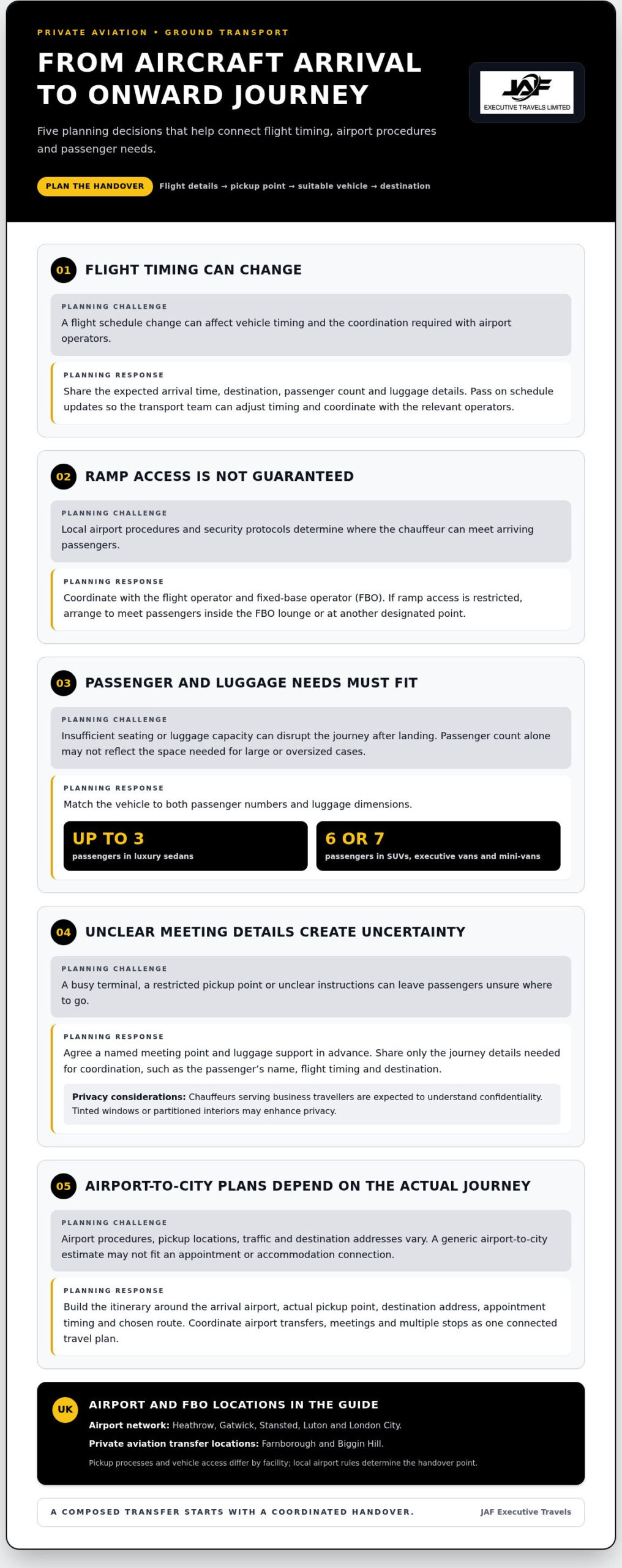
A smooth private aviation transfer connects an aircraft arrival with the passenger’s onward journey. The plan brings together flight timing, airport procedures, vehicle suitability and discreet passenger care.
Coordinating the Arrival
Ground handling can include arranging passenger transport, so the vehicle plan should be coordinated with the flight operator and fixed-base operator (FBO). Share the expected arrival time, destination, passenger count and luggage details to help prepare the pickup. If the flight schedule changes, updated information allows the transport team to adjust vehicle timing and coordinate with the relevant airport operators.
At a private aviation arrival, the aircraft typically taxis to the FBO ramp. Passengers leave the aircraft near the terminal while the crew handles their luggage. Local airport procedures and security protocols determine where the chauffeur can meet them. Ramp pickup is not guaranteed. If access is restricted, passengers may meet the chauffeur inside the FBO lounge instead.
Passenger Privacy and Security
Passenger privacy and security involve protecting personal details and limiting unnecessary exposure during a transfer. This matters when executives need confidential conversations or a discreet transition between the aircraft and their destination.
Share only the journey details needed to coordinate the pickup, such as the passenger’s name, flight timing and destination. Chauffeurs serving business travellers are expected to understand confidentiality. Tinted windows or partitioned interiors may enhance privacy, while a named meeting point helps passengers find their way in a busy terminal.
Vehicle Types and Passenger Capacity
Vehicle choice matches passenger numbers and luggage needs to a suitable vehicle. This matters because insufficient seating or luggage capacity can disrupt the journey after landing.
Luxury sedans used for executive transport can carry up to three passengers. SUVs, executive vans and mini-vans can accommodate six or seven passengers. Consider luggage dimensions and oversized items alongside passenger count. For example, a group carrying large cases may require a different arrangement from the same number of travellers with cabin bags.
Safety Standards and Transport Risks
Licensing and insurance depend on the chauffeur service, vehicle and operating location. Airport access follows the facility’s local procedures. Safety planning focuses on a suitable vehicle, a competent chauffeur and clear pickup instructions.
Key risks include flight-time changes, restricted ramp access, insufficient passenger or luggage capacity, and unclear meeting arrangements. These can delay a transfer or leave passengers unsure where to go. Sharing flight updates, passenger needs and the meeting point helps coordinate the handover. In destinations with higher security risks, trip support teams may recommend security-trained drivers, suitable vehicles and coordination with local security agencies.
UK airport ground transportation companies
Ground transport logistics for private aviation clients in the UK connect airport operations with onward travel, from charter arrival to city destination. Each airport’s procedures shape practical details, including vehicle access, pickup location and coordination with airport operators.
Airport Access Across the UK
Airport access involves planning a vehicle’s movements and passenger pickup around the facility’s operating arrangements. This matters because private aviation transfer access depends on local airport procedures, not one nationwide process.
At an airport with an FBO, transport operators can coordinate arrangements with the facility. If aircraft ramp access is restricted, the chauffeur may meet passengers in the FBO lounge. For ground transport logistics for private aviation clients in the UK, the airport and FBO determine the pickup process and vehicle access. Sharing accurate arrival details and the meeting location with the relevant operators supports the handover.
Airport locations also shape the onward plan. Heathrow, Gatwick, Stansted, Luton and London City serve different parts of the London travel network, while Farnborough and Biggin Hill are private aviation transfer locations. Start the pickup plan with the arrival airport and passenger destination, rather than assuming every charter uses the same facility or access route.
Airport-to-City Drive Times
Airport-to-city drive time is the road journey between an airport and a destination, shaped by the route and traffic. It matters when an arrival connects with an appointment or accommodation.
Plan around the actual pickup point and destination address. A journey from London City Airport to a nearby business district differs from a transfer to central London from another airport. Appointment timing and the chosen route also affect the itinerary. Use the planned addresses to set a realistic sequence for the day instead of relying on a generic airport-to-city estimate.
Chauffeur Transfers at UK Airports and FBOs
Chauffeur transfers at UK airports and FBOs connect a passenger’s arrival facility with their destination. Clear arrangements matter because airport terminals and private aviation facilities can have different pickup procedures.
Transfers can be arranged for Heathrow, Gatwick, Stansted, Luton and London City, as well as private jet journeys at Farnborough and Biggin Hill. FBO services and vehicle access differ by facility. Airport rules and security protocols determine whether a vehicle can approach the aircraft or must meet passengers at another designated point.
International operators can coordinate journeys across cities, while local airport procedures guide each transfer. Match the service to your airport and destination, then agree the appropriate pickup arrangement. These details help create a more considered journey from arrival to onward travel. For a tailored itinerary, explore UK airport transfer arrangements suited to your plans.
Personalizing chauffeur, vehicle, and route preferences
A personalised transfer starts with a concise travel brief connecting the flight, passenger preferences and onward itinerary. These details help match the vehicle and chauffeur arrangement to the journey, rather than treating every airport pickup alike.
For a UK private aviation transfer, provide the flight schedule, passenger count, destination, appointment times and luggage details. Include bag dimensions and oversized items, such as golf clubs, so vehicle selection accounts for luggage capacity. Add child seat requests and any mobility or assistance requirements to the same brief.
Route preferences matter too. A passenger travelling from an airport to a central London meeting may want a direct journey, while someone with several appointments may need a route linking each address. Share preferred pickup points, planned stops and timing priorities. The chauffeur can use these details to shape the itinerary.
Choose a vehicle to suit the group’s needs, not appearance alone. A luxury sedan may suit an individual executive, while an SUV or executive van may better fit a group or extra baggage. Mercedes-Benz S-Class and V-Class vehicles offer different executive travel options, while a Range Rover Autobiography provides an SUV option. Match the vehicle to passenger comfort, luggage and the purpose of the trip.
For group transfers, provide one passenger list and a shared itinerary to coordinate multiple vehicles. A group arriving on the same flight may need vehicles positioned together, while colleagues travelling to separate meetings may need different destinations. Clear names, pickup instructions and stop sequences help each chauffeur follow the plan.
In-vehicle preferences may include seating, climate control, entertainment and connectivity. If a passenger needs a mobile office, state the requirements before travel, including whether in-vehicle Wi-Fi matters. Connectivity and entertainment options vary by vehicle, so sharing priorities helps guide selection without assuming every vehicle has identical equipment.
Include accessibility and special assistance requirements before assigning a vehicle. Describe the passenger’s boarding needs and any airport support required, then align the pickup point and vehicle choice accordingly. Request a child seat as part of the travel brief, providing the child’s age and size to guide the arrangement.
Preferences may change after a flight or appointment update. Share revised timings, destinations or stop requests with the transport coordinator promptly. This keeps the chauffeur’s route aligned with the latest itinerary and supports a smooth, comfortable journey from arrival to final destination.
Ground transport providers can accommodate passenger preferences for vehicle types, amenities, chauffeurs and routes where possible. Options may include luxury sedans, SUVs and executive vans with comfortable seating, climate control, entertainment systems and connectivity.
Meet-and-greet and luggage services
A meet-and-greet arrangement gives arriving passengers a clear handover point, while luggage support connects airport handling with the onward destination. For a private aviation arrival, specify who meets the passenger, where the meeting takes place and how bags move from the aircraft to the vehicle or another address.
At an FBO, a chauffeur may meet passengers inside the private lounge when airport procedures restrict ramp access. The arrival brief should identify the passenger, flight and agreed meeting point. If the aircraft or pickup arrangement changes, sharing the update with the transport operator and FBO helps keep the handover aligned with the revised schedule.
Luggage details involve more than the number of cases. Share the number and dimensions of bags, including oversized items, and state whether they travel with the passenger. When requested, transport providers may arrange for airport luggage to be collected and sent to a hotel or another location. For example, a passenger travelling directly to a London meeting could have bags delivered separately, leaving the vehicle cabin clear for the journey.
FBO support can shape the arrival experience before the chauffeur pickup. At major UK airports, FBO lounges may have dedicated officers handling passport checks and customs clearance for private jet passengers. At airports without dedicated FBO facilities, passengers may use the same passport-control and customs queues as commercial travellers. These differences can affect the arrival sequence, so the meeting plan should account for the passenger’s route through the airport.
Reliability comes from clear operational communication, not the assumption that every flight lands exactly on schedule. Transport providers can monitor flight status and position vehicles for early arrivals, delays or last-minute changes. Sharing updated flight information, passenger details and the pickup point gives the operator practical information to adjust vehicle timing. Clear meeting instructions also help avoid confusion when several passengers arrive together.
Colleague shuttle services require coordination between the group’s arrival details and each onward destination. A transport operator can coordinate luxury vehicles or executive coaches for private jet groups. For example, colleagues arriving on one charter might travel together to a hotel, while passengers with separate meetings need vehicles assigned to different addresses. A passenger list, destination list and agreed stop sequence help define the arrangement.
For a smooth transfer, settle three details in the arrival plan: the FBO or terminal meeting point, whether luggage travels with passengers, and each destination. These specifics improve the handover between airport teams and chauffeurs, helping passengers move from aircraft arrival to onward travel with less uncertainty.
Ground transport for executive and corporate travel
For corporate travellers, ground transport is part of the business itinerary, connecting airport arrivals with meetings, accommodation and scheduled stops. A useful plan links flight timing to the day’s commitments rather than treating each transfer as an isolated journey. This is especially valuable for roadshows, where several appointments depend on coordinated vehicle movements and punctual arrivals.
Arrange a premium private aviation car service 24 to 48 hours before the scheduled departure. This gives the transport team time to map the itinerary, allocate suitable vehicles and coordinate with flight operators. Share the airport, destination addresses, appointment sequence, passenger details and luggage requirements together. A complete brief helps prevent gaps between arrival, hotel check-in and the first meeting.
Flight timings can change, so operational coordination should continue after the initial booking. Ground transport providers monitor flight status to position vehicles for early arrivals, delays and last-minute changes. For an executive travelling from a private terminal to a London meeting, a revised arrival time can affect the pickup and onward schedule. Timely updates help keep the vehicle plan aligned with the flight.
Roadshows require a broader view than a single airport transfer. The itinerary may connect several offices, client meetings and overnight stays, with different passengers joining at different points. A transport coordinator can map each stop, assign vehicles to passenger movements and share driver details in advance. Travellers can then contact the driver about delays or issues, while the itinerary remains clear to the team.
For a day with several stops, sequence appointments by location and allow time for travel between them. In London, traffic and changing meeting locations can affect the route, so keep priorities and destinations clear. If an executive’s meeting runs late, update the transport coordinator to adjust the next pickup. The goal is a composed journey, not a minute-by-minute itinerary that cannot adapt.
Corporate travel arrangements can cover transfers between airports, meetings and accommodation. For an international itinerary involving several cities, operators can coordinate ground transport across locations. Keep the passenger list, flight updates and meeting schedule together, so each operator works from the same travel plan. This is particularly useful when colleagues travel on separate flights but share a roadshow schedule.
Ground transport may be itemized separately from a private jet charter, depending on passenger preferences and local market availability. To arrange coordinated executive travel around your itinerary, discuss your corporate journey with a chauffeur team.
JAF Executive Travels: Mercedes-Benz S-Class Chauffeur Service
JAF Executive Travels provides a Mercedes-Benz S-Class Chauffeur Service for private aviation passengers seeking a composed executive transfer. It suits solo travellers or small groups whose itinerary calls for a professional chauffeur and a refined onward journey.
For different passenger and luggage needs, the Mercedes-Benz V-Class Chauffeur Service, Mercedes-Benz E-Class Chauffeur Service and Range Rover Autobiography Chauffeur Service offer further vehicle options. Share your arrival details, destination, passenger requirements and preferred meeting point to shape the transfer around your itinerary.
Whether you are travelling from an airport to a business meeting or arranging a tailored journey, a suitable vehicle and clear pickup instructions help make the transition smoother. Contact JAF Executive Travels to discuss your chauffeur journey.
Plan Your Next Journey with Confidence
Use your next itinerary to set a clear standard for the ground journey: a discreet handover, a suitable vehicle and arrangements that respect your schedule. Planning ground transport logistics for private aviation clients in the UK means considering how each choice supports the passenger’s wider travel plans, from arrival to final destination.
JAF Executive Travels offers Mercedes-Benz S-Class, V-Class and E-Class Chauffeur Services for different executive travel needs. Share your preferred vehicle, destination and journey requirements to shape an arrangement around your plans.
A thoughtful transfer can give you more room to focus on the reason for your journey. Contact JAF Executive Travels to discuss your upcoming chauffeur journey and take the next step towards a more composed travel experience.
Frequently Asked Questions
What ground transport services are available for private aviation clients in the UK?
UK private aviation passengers can arrange airport chauffeur transfers, private jet transfers, corporate roadshow management and UK-wide chauffeur travel. JAF Executive Travels offers transfers at Heathrow, Gatwick, Stansted, Luton and London City airports, plus private jet transfers at Farnborough and Biggin Hill. The right service depends on your arrival airport and onward itinerary, whether you need a direct hotel journey or transport between corporate appointments. London Sightseeing Private Tours can also suit a planned city visit.
How do I book ground transport for a private jet arrival or departure in the UK?
Share your journey details with the chauffeur provider, including whether you need an arrival pickup or departure transfer, the airport, flight schedule, passenger count, destination and luggage needs. For a departure, include your pickup address and required airport arrival time. For an arrival, identify the private terminal or FBO and onward destination. Include child seat or accessibility requirements, and pass on itinerary changes promptly so the transport plan can be updated.
What vehicle options are available for UK private aviation transfers, including luggage and group capacity?
JAF Executive Travels offers Mercedes-Benz S-Class, E-Class and V-Class Chauffeur Services, plus a Range Rover Autobiography Chauffeur Service. The S-Class and E-Class each accommodate up to three passengers and two pieces of luggage. The V-Class accommodates up to five passengers and six pieces of luggage. Check the vehicle’s passenger and luggage capacity when booking to ensure it suits your group. Match the vehicle to your passenger numbers and baggage needs.
Are there UK airport access, meet-and-greet, parking, or security rules affecting private aviation ground transport?
Yes. Airport access, meeting points, parking and security procedures vary by airport and FBO, so the same arrangement does not apply across the UK. Airside vehicle access follows local rules and security protocols and is not guaranteed. When ramp access is restricted, an FBO lounge pickup is the usual alternative. Parking and waiting plans should follow the airport’s designated arrangements, while passenger processing can vary between facilities.

Tom Copper
Tom Copper is a UK-based travel and tourism writer with a deep passion for transforming journeys into compelling stories. Over the years, he has explored both iconic destinations and lesser-known hidden gems, always seeking experiences that create meaningful connections between people and places. His writing reflects a genuine appreciation for culture, history, and adventure, blending practical travel advice with thoughtful personal insights. From vibrant city breaks and scenic coastal escapes to peaceful countryside retreats, Tom shares travel inspiration that feels authentic, relatable, and exciting. When he’s not crafting his next article, you’ll likely find him wandering through local markets, sampling new cuisines, or capturing unique moments through his camera lens. For Tom, travel is never just about ticking destinations off a list—it’s about the stories, emotions, and memories created along the way.

Ground transport logistics for private aviation clients in the UK
Ground transport logistics for private aviation clients in the UK depend on matching the vehicle…

Safe transport for solo female travellers in London
London is practical to explore alone when you plan your journeys and stay aware of…

Chauffeur for Executive Relocation Home Search in London
Can a chauffeur make a London home-search day easier to manage? Yes, when travel between…
How to Add a Stop to a Pre-Booked Chauffeur Trip
Could an unrecorded stop put the rest of your carefully planned journey under pressure? If…

Making a Special Occasion Memorable with a Chauffeur
What if the journey felt like part of the celebration, rather than another detail to…
How to Impress a Client with an Airport Pickup Service
A client’s first impression of your organisation can take shape before the meeting even begins.…

How Much Does It Cost to Hire a Driver for a Day in the UK?
What should you consider when arranging a driver for a day? If you’re asking how…

Executive Chauffeur for London Business Meetings
A morning briefing, a client meeting across town and a final appointment before the day…

Business Class Chauffeur Experience in London: What to Expect
If you’re comparing options for a “business class chauffeur experience london,” look beyond the vehicle.…

Last-Minute Airport Chauffeur London: A 2026 Booking Guide
When a flight or itinerary changes at short notice, finding a vehicle is only part…