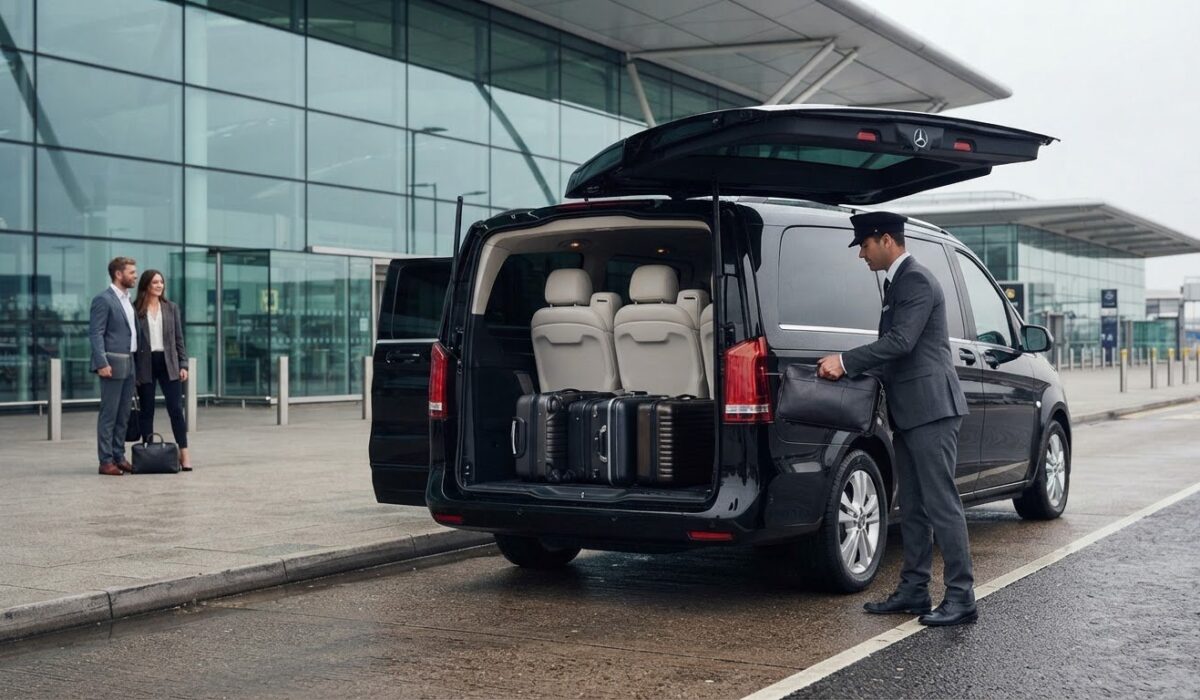
The longest Mercedes V-Class doesn’t automatically make every journey easier to plan. Mercedes V-Class luggage capacity depends on the vehicle configuration and how your group will travel, so a suitcase count alone may not tell the whole story. The aim is to match the journey’s practical needs with a comfortable arrangement for passengers and their belongings.
It’s natural to focus on whether every bag will fit. But a good travel plan also considers how easily passengers can settle in, keep essentials accessible and travel without luggage getting in the way. A business trip, family airport transfer and weekend away can each call for a different balance.
This guide explains how the vehicle version and seating layout affect usable space, and what to consider when packing unusually shaped or bulky items. You’ll also find ways to describe your passengers and luggage clearly when arranging a journey. With these details in mind, you can make a more informed choice and plan with greater confidence.
Key Takeaways
- Compare the seating layout and vehicle length, since both affect how much space remains for luggage.
- With seven passengers and several large suitcases, assess the total load carefully; another transport arrangement may be more comfortable.
- Include pushchairs, mobility equipment and cabin bags in your luggage plan, especially when items are bulky or awkwardly shaped.
- Sharing passenger numbers and bag sizes helps match your journey to a suitable chauffeur vehicle, including a Mercedes-Benz V-Class.
Why does luggage capacity vary?
Mercedes V-Class luggage capacity changes with seating layout, passenger numbers and bag dimensions. The model can seat up to eight adults, while a specific configuration may carry up to 7 passengers.
Passenger Counts and Available Luggage Space
Passenger count affects how much of the interior remains available for luggage. With 2 to 4 passengers, a V-Class generally has room for several large suitcases and carry-on bags. At 5 to 6 passengers, the number and dimensions of each case matter more. Maximum payload is vehicle-specific; passenger weight contributes to the load, leaving less capacity for luggage.
For a useful comparison, count every traveller and bag, including cabin cases and backpacks. Two groups with the same suitcase count may need different amounts of space if one has wider or taller cases. A change in seating layout can also alter the luggage area, so passenger capacity alone doesn’t show how much baggage will fit.
Travelling With Seven Passengers
Travelling with 7 passengers leaves less room for suitcases than travelling with fewer people. A V-Class carrying 7 passengers with 7 large suitcases or more may require a different transportation solution. The deciding details are the case dimensions, the seating arrangement and whether everyone also carries cabin bags.
For example, seven large cases plus seven cabin bags need more space than seven large cases alone. Don’t plan to place luggage in passenger areas, as this can reduce comfort and access. The V-Class can seat up to eight adults, but usable luggage space still depends on the configuration.
Comparing Capacity With Other Vans
There’s no single luggage-capacity ranking for a V-Class, a Mercedes-Benz Vito and other vans. Available space depends on the vehicle, its seating layout and the number of seats in use. A passenger Vito’s luggage area also changes with its configuration and passenger count.
Compare the actual passenger and luggage arrangement rather than relying on the vehicle name alone. A van carrying fewer passengers may leave more room for cases than one using more seats. For a like-for-like comparison, consider the number of travellers, suitcase dimensions and cabin bags together. These details give a clearer picture than passenger capacity alone.
Vehicle version, length, and seating layout
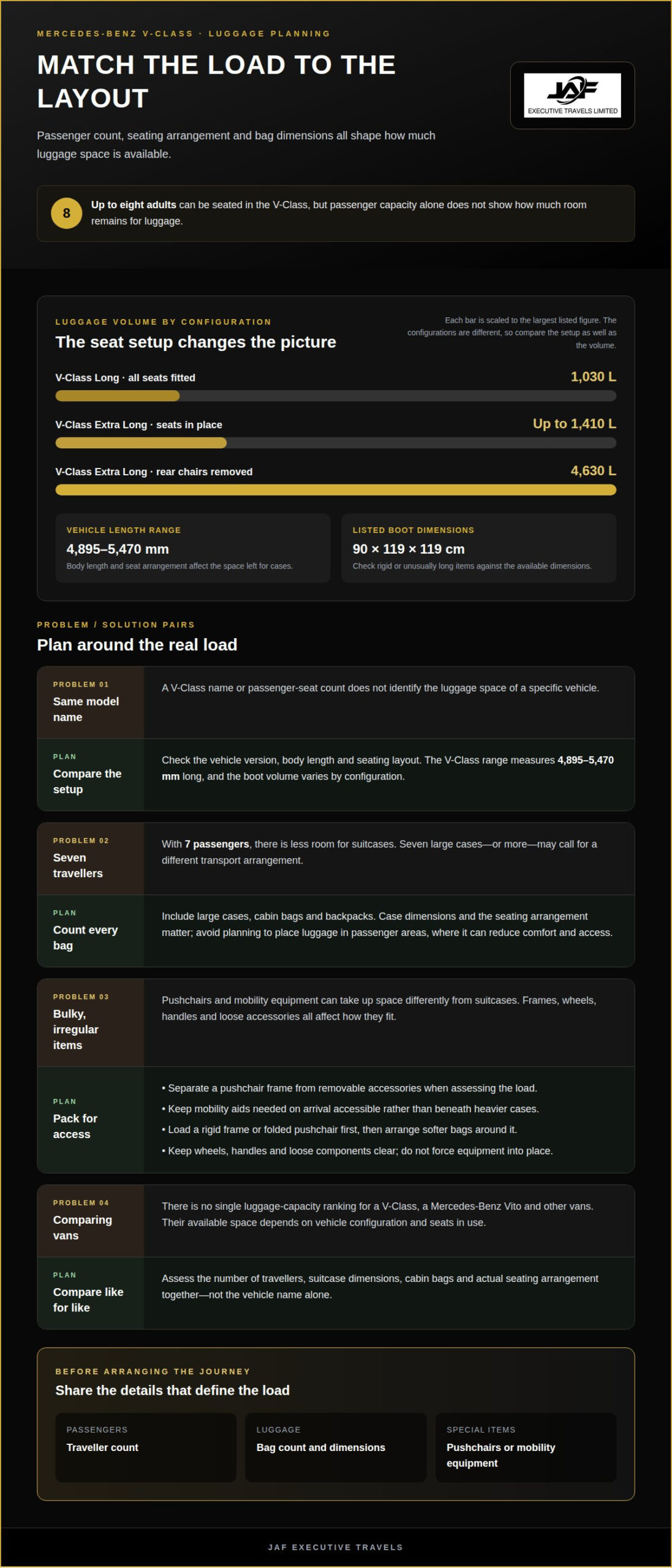
Mercedes V-Class luggage capacity ranges from 1,030 to 3,200 litres, depending on configuration. Body length and seat arrangement help explain where your version sits within that range.
Luggage Volume by Seating Configuration
Luggage volume describes the space available behind or around the passenger seats. The V-Class range measures 4,895-5,470 mm long, and its boot capacity varies by configuration. This matters because a longer body or different seating layout can change the space left for cases.
The Mercedes-Benz V-Class Long offers 1,030 litres with all seats fitted. The Extra Long provides up to 1,410 litres with seats in place. With rear chairs removed, the Extra Long has 4,630 litres. These figures show why comparing body version and seat setup gives a clearer estimate than relying on the model name alone.
Capacity With Every Seat in Use
With every seat fitted, the Long version has 1,030 litres of luggage space; the Extra Long has up to 1,410 litres. The V-Class seats up to eight adults, though the available boot volume depends on its configuration. For a full passenger load, the Extra Long’s listed volume offers a useful comparison point.
The V-Class was introduced in 2014 and received facelift updates in 2019. Luggage volume is presented by configuration, not as a single figure for every model year or trim. Body length and seat arrangement are therefore practical details to compare when assessing a specific vehicle.
The listed boot dimensions are 90 cm long, 119 cm wide and 119 cm high. These measurements help assess whether a case can fit through the opening and sit within the cargo area; they don’t describe every usable space around the seats. Measure unusually long or rigid items against the available dimensions before planning how they’ll travel.
If a chauffeur-driven journey suits your plans, the Mercedes-Benz V-Class Chauffeur Service offers a tailored travel option.
Pushchairs, mobility equipment, and other bulky items
A pushchair or wheelchair can take up space differently from a suitcase because its frame, wheels and handles create an uneven shape. Before packing, identify which parts fold and whether accessories, such as a rain cover or footrest, travel separately. Keeping those pieces together helps you account for the complete item, rather than estimating from its main frame alone.
Mobility equipment may also need to stay accessible during the journey. For example, a walking aid needed immediately after arrival shouldn’t be buried beneath heavier cases. Separate essential equipment from items that can be loaded last, and consider how passengers will reach it at the destination. This small distinction can make loading and unloading more orderly.
Loading order matters for irregular items. Place a rigid frame or folded pushchair first, then arrange softer bags around it. Don’t force equipment into a position that catches a handle or puts pressure on a moving part. If several pieces travel together, keep detachable accessories grouped so they don’t disappear among coats, cases or other belongings.
- Separate the pushchair frame from removable accessories when assessing the load.
- Set aside mobility aids that passengers need as soon as they arrive.
- Keep wheels, handles and loose components clear of other packed items.
Consider the journey itself, not just the departure point. On an airport transfer, a family may need a folded pushchair alongside suitcases and hand luggage; on a day trip, the same pushchair may need to stay easy to retrieve. A mobility aid can also affect how other items are arranged. Describe the equipment and its parts as clearly as the rest of your luggage, so the travel plan reflects the actual load.
Mercedes V-Class luggage considerations
A luggage-volume figure doesn’t guarantee that a particular case will fit in a particular position. A fitment review reports that 9 of 100 tested products fit the Mercedes-Benz V-Class only with seats folded. This illustrates the difference between available volume and usable shape: a suitcase may need a specific orientation or more open floor space than the seating arrangement allows.
Some individual examples are listed as fitting with seats up. These include the 138-litre Samsonite S’Cure Spinner XL, the 114-litre Hanke Reisekoffer 28Inch and the 101-litre Wenger Ibex Trunk. The 102-litre Samsonite S’Cure Spinner L is also listed. These cases offer reference points, but equal capacities don’t ensure equal fit, since their external shapes can differ.
Seat position changes the loading options. Folding a seat can create room for an item that otherwise won’t fit, but it also changes the passenger arrangement. Removing V-Class seats completely is a job for two people because of their weight. It’s a substantial change, not a quick adjustment during ordinary loading.
- Check whether each item is listed for the seats-up or folded configuration.
- Keep the passenger seating arrangement in mind before folding seats.
- Allow for the handling involved if seats must be removed completely.
For example, a case that fits with the seats up may be the more practical choice when the passenger layout needs to stay intact. By contrast, an item that requires folded seats calls for a different arrangement. Fit depends on the specific case and vehicle configuration, not just the litre figure printed on a suitcase. This helps prevent volume estimates from being mistaken for a guaranteed fit.
For a journey planned around passenger comfort and luggage needs, plan a V-Class chauffeur journey.
JAF Executive Travels: Mercedes-Benz S-Class Chauffeur Service
JAF Executive Travels offers chauffeur services for journeys where comfort, passenger needs and luggage planning matter. For a group travelling with suitcases, the Mercedes-Benz V-Class Chauffeur Service is a relevant option; the Mercedes-Benz S-Class Chauffeur Service may suit a different passenger arrangement. The right choice depends on who is travelling and what they need to bring.
Share your passenger count, suitcase quantity and approximate bag dimensions when arranging your journey. Include pushchairs, mobility equipment and cabin bags so the planned vehicle can account for the full load. These details help shape a considered travel arrangement without treating luggage as an afterthought.
For a refined journey with a different vehicle preference, JAF Executive Travels also offers Mercedes-Benz E-Class and Range Rover Autobiography Chauffeur Services. Contact JAF Executive Travels to discuss your journey requirements.
Plan a journey that feels effortless
Understanding Mercedes V-Class luggage capacity helps you plan around comfort, rather than letting bags dictate the experience. Think beyond the vehicle itself: a well-planned itinerary should account for who is travelling, what they need to bring and how they want the journey to feel.
That perspective can make the next decision simpler. Choose the vehicle and travel arrangement that best support your priorities, whether you value shared space, a quieter executive journey or a composed arrival. A professional chauffeur service can bring these details together with discretion and care.
For a considered journey tailored to your travel plans, speak with JAF Executive Travels. Share what matters for your trip and take the next step with confidence.
Frequently Asked Questions
How Many Suitcases Can Fit in a Mercedes V-Class?
There isn’t one suitcase count that applies to every Mercedes V-Class journey. A few large cases may fit comfortably with a smaller passenger group, while the same cases can crowd the luggage area when more seats are occupied. Mercedes V-Class luggage capacity depends on configuration and bag dimensions. Include cabin bags and backpacks in your estimate, as they also need secure space.
Can 7 passengers travel with luggage in a V-Class?
Yes, a V-Class can carry 7 passengers in some configurations, but luggage needs careful consideration. Seven passengers travelling with 7 large suitcases or more may need a different transport arrangement. A practical example is a group arriving with both checked cases and cabin bags: the extra pieces can make the load harder to accommodate while keeping passenger space usable.
How much space is there?
The V-Class boot capacity ranges from 1,030 to 3,200 litres, depending on configuration. For planning, treat the volume as a guide rather than a direct suitcase count. Case shape affects how efficiently bags fit: a rigid case with protruding wheels can use space differently from a soft holdall. The seating layout also determines how much of the vehicle’s interior is available.
When should you consider a larger vehicle?
Consider a larger vehicle or an additional vehicle when passengers and baggage cannot be accommodated without compromising the usable passenger area. One clear example is 7 passengers travelling with 7 large suitcases or more. Also account for pushchairs, mobility equipment and cabin bags. Their size and shape can affect the arrangement even when the main suitcase count seems manageable.
What is the V-Class cargo capacity with the rear seats folded or removed?
With the rear chairs removed, the V-Class Extra Long has 4,630 litres of luggage capacity. That figure applies to seats removed, not simply folded. Folding seats changes the cargo layout, but the listed volume differs by configuration. Seat removal is a substantial adjustment, so consider whether the passenger seating arrangement still suits the journey before planning around the larger load space.
How does luggage capacity vary between V-Class wheelbase options?
The Long and Extra Long versions have different listed luggage volumes. The Long provides 1,030 litres with all seats fitted, while the Extra Long offers up to 1,410 litres with seats in place. The Extra Long’s greater length can provide more room, but the practical difference depends on its seating arrangement and the dimensions of the luggage you plan to carry.

Tom Copper
Tom Copper is a UK-based travel and tourism writer with a deep passion for transforming journeys into compelling stories. Over the years, he has explored both iconic destinations and lesser-known hidden gems, always seeking experiences that create meaningful connections between people and places. His writing reflects a genuine appreciation for culture, history, and adventure, blending practical travel advice with thoughtful personal insights. From vibrant city breaks and scenic coastal escapes to peaceful countryside retreats, Tom shares travel inspiration that feels authentic, relatable, and exciting. When he’s not crafting his next article, you’ll likely find him wandering through local markets, sampling new cuisines, or capturing unique moments through his camera lens. For Tom, travel is never just about ticking destinations off a list—it’s about the stories, emotions, and memories created along the way.
Car Service from Canary Wharf to Heathrow: How Much
A car service from Canary Wharf to Heathrow covers approximately 37 km and typically takes…
Mercedes V-Class luggage capacity and suitcase space
The longest Mercedes V-Class doesn’t automatically make every journey easier to plan. Mercedes V-Class luggage…
Chauffeur Driven Tour of Bath and Stonehenge from London
A private chauffeur driven tour of Bath and Stonehenge from London lasts 10 hours, bringing…
Private car service to Wimbledon with waiting and return pickup
A smooth Wimbledon journey depends on planning the return as carefully as the arrival. Book…
Chauffeur Driven to Cheltenham Festival Gold Cup
Being chauffeur driven to the Cheltenham Festival Gold Cup doesn’t have to mean arranging a…
Goodwood Festival of Speed transport from London by private car
For Goodwood Festival of Speed transport from London, a private car transfer gives you a…
Celebrity Transport With Non-Disclosure Agreements and Privacy
A discreet vehicle is only one part of a private journey. Celebrity transport with a…
Car service from The Goring Hotel to Farnborough
A car service from The Goring Hotel to Farnborough is a pre-arranged chauffeur transfer, with…
The Connaught Hotel to Heathrow Terminal 5 Car Service Cost
A punctual airport transfer is about more than the distance on the map. The Connaught…
Chauffeur from St Pancras International to Your Hotel
A chauffeur from St Pancras International to your hotel can simplify your arrival. Choose a…