
What if the most disruptive part of an executive journey isn’t the distance, but the handovers between each stage? Reducing travel friction for a senior management team starts with recognising how separate bookings, waiting times and shifting schedules can unsettle even a carefully planned day.
When meetings are tightly timed, reliable ground transport is more than a connection between destinations. It can help leaders arrive composed, protect working time and provide a quieter, more private space between commitments. A coordinated plan, supported by professional chauffeurs and a tailored itinerary, makes each part of the journey easier to manage.
This article explains how to make executive travel more predictable, comfortable and discreet. You’ll learn how joined-up planning can reduce stressful handovers, how a dedicated chauffeur vehicle can support work on the move, and how clear communication can help when plans change. From corporate roadshows to airport transfers and multi-stop itineraries, thoughtful ground transport gives senior teams greater clarity and peace of mind throughout the day.
Key Takeaways
- Map each travel handover, from itinerary planning to arrival updates, and assign a clear owner to every step.
- Choose point-to-point transfers or hourly and daily chauffeur bookings based on the itinerary, number of stops and need for flexibility.
- Prepare accurate passenger details and an agreed update process so the team can respond calmly when plans shift.
- Use live traffic data to inform route choices, while allowing realistic flexibility around arrival times.
- Reducing travel friction for a senior management team means coordinating professional chauffeur support with privacy, comfort and a tailored itinerary in mind.
Reducing travel friction for senior management teams starts with the whole journey
A tightly scheduled executive day can be unsettled by a small mismatch: an unclear pickup point, a booking that doesn’t align with an arrival, or a change that reaches one person but not the rest of the team. Each issue may seem minor on its own. Together, they can distract from meetings and create extra work for the people coordinating the day.
Travel friction is avoidable effort, uncertainty or delay between stages of a journey. It differs from disruption that planning cannot prevent, such as an unexpected traffic incident. Preparation can’t make every journey go exactly to plan, but it can clarify responsibilities, reduce preventable confusion and help the team respond when circumstances change. That is the practical aim of reducing travel friction for a senior management team: protecting time, comfort, privacy and attention without promising a perfect trip.
Business travel brings people together for work, but the journey supporting those commitments deserves attention too. Consider how a leader moves from home to the airport, from the airport to a vehicle, then on to meetings and onward travel. Each transition is a handover. If the next step isn’t clearly arranged, uncertainty can build at the point when the traveller needs to move on.
Where friction enters an executive journey
Unclear pickup instructions, separate bookings with mismatched timings, or missing updates can leave a traveller or assistant chasing information at the moment it’s needed. If a flight or meeting time changes, the assistant may need to revise arrangements, the traveller may need to adjust expectations, and colleagues at the destination may need to reconsider their schedules. A coordinated itinerary makes these connections visible and reduces avoidable back-and-forth.
Why senior management travel needs a considered approach
Punctuality matters because meetings, decisions and other people’s time depend on it. A calm, discreet vehicle can also give an executive space to prepare, take a private call or pause between commitments. These are priorities to plan for, not outcomes anyone can guarantee in every circumstance.
A considered plan treats the journey as one connected sequence rather than a set of separate bookings. When each transition has clear details and someone responsible for communicating changes, leaders and their support teams can focus more fully on the work ahead.
Map each handover to reduce friction across executive travel
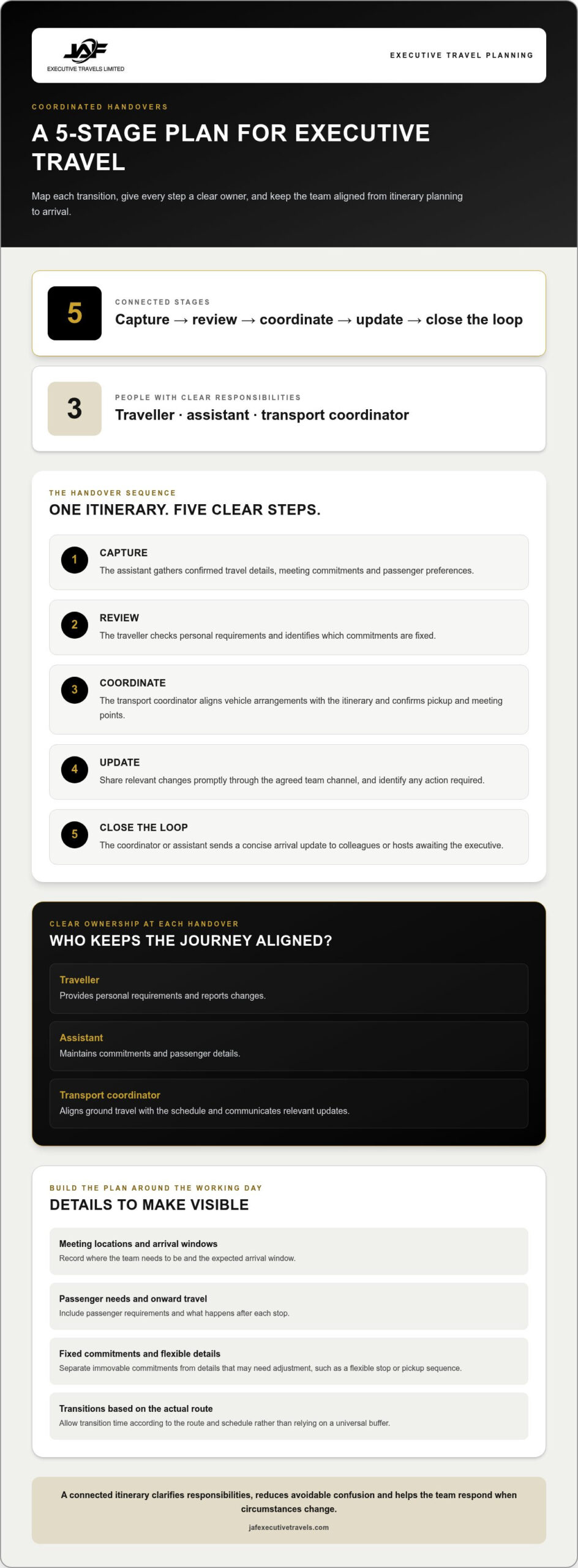
A clear journey plan gives everyone involved the same view of what happens next. For reducing travel friction for a senior management team, map every stage from the initial itinerary to the final arrival update, and assign an owner to each handover. The traveller provides personal requirements and reports changes; the assistant maintains commitments and passenger details; the transport coordinator aligns ground travel with the schedule and communicates relevant updates.
Build one itinerary around the team’s actual commitments
Start with the working day, not simply departure and arrival times. Record meeting locations, expected arrival windows, passenger needs and onward travel requirements. Mark immovable commitments separately from details that may need adjustment, such as a flexible stop or pickup sequence. Allow time for transitions based on the actual route and schedule rather than relying on a universal buffer.
A practical sequence helps keep responsibilities clear:
- 1. Capture: The assistant gathers confirmed travel details, meeting commitments and passenger preferences.
- 2. Review: The traveller checks personal requirements and identifies which commitments are fixed.
- 3. Coordinate: The transport coordinator aligns vehicle arrangements with the itinerary and confirms the agreed pickup and meeting points.
- 4. Update: Whoever receives a relevant change shares it promptly through the team’s agreed communication channel and identifies any action required.
- 5. Close the loop: The coordinator or assistant sends a concise arrival update to colleagues or hosts awaiting the executive.
Make airport and ground-transport handovers clear
Airport arrivals bring together flight information, a meeting point and the next destination. Flight tracking helps the team follow changes to an arrival, while clear meet-and-greet instructions tell the traveller where the ground journey begins. For airport-to-vehicle planning, the Heathrow chauffeur service guide offers further detail on coordinating this transition.
A professional chauffeur supports the journey from the airport to the next destination, while the assistant or transport coordinator manages itinerary changes and keeps relevant colleagues informed. Clearly assigned handovers connect flight updates, pickup instructions, passenger needs and onward destinations, so each person knows what to communicate and who is responsible for the next step.
Coordination matters beyond the vehicle: Harvard Business School discusses how business travel propels innovation through collaboration. A well-managed itinerary helps protect the purpose of those in-person commitments. For corporate journeys, JAF Executive Travels’ chauffeur support can form part of a carefully coordinated travel plan.
Choose the right travel arrangement for the team’s schedule
The most suitable chauffeur arrangement depends on how much of the journey is known in advance. A direct airport transfer suits a clear pickup and destination, while hourly or daily chauffeur bookings may be better for a day with several stops or a schedule that could change. For teams focused on reducing travel friction for a senior management team, choose the arrangement that fits the itinerary rather than defaulting to one format.
Consider three factors: how certain the schedule is, how many destinations are involved, and how much flexibility the day may require. This helps match ground transport to the work itself, rather than adding unnecessary coordination around it.
When a planned airport transfer fits the journey
When dedicated chauffeur time supports a changing itinerary
Hourly or daily bookings suit schedules with several planned stops, such as a series of client meetings or a corporate roadshow. A dedicated vehicle and chauffeur support the itinerary across those stages, reducing the need to coordinate separate journeys. This arrangement can also leave room to adjust the sequence when a meeting runs longer or a commitment changes, subject to the agreed booking arrangements.
For some executives, the vehicle can serve as a mobile office, offering a private setting to review notes, prepare for a meeting or make calls between destinations. Consider this alongside comfort and discretion, without assuming every journey or vehicle will meet the same working needs. The chauffeur hire guide provides further context on booking arrangements.
Prepare a senior management travel plan that can adapt
A useful travel plan is specific enough to guide the day, yet simple enough to update when circumstances change. For reducing travel friction for a senior management team, establish who owns the itinerary, who can approve changes and how essential updates will reach the traveller and transport coordinator.
Create a clear travel brief for every journey
Give everyone working from the plan one reliable reference for the details that affect the journey. Include:
- Pickup and drop-off points, meeting locations and scheduled timings.
- Passenger names, relevant preferences and contact details for the responsible coordinator.
- Luggage capacity needs, so the vehicle arrangement reflects the party’s baggage.
- A child seat requirement, when relevant to the travelling party.
- Which commitments are fixed and which parts of the itinerary may be adjusted.
- The agreed communication channel and the person responsible for sharing changes.
Keep the brief focused on information needed to coordinate the trip. Share essential changes promptly with the traveller and the person managing transport, especially if a revised meeting time affects a pickup or onward journey.
Prepare for changes without overcomplicating the plan
Agree in advance which changes call for immediate communication. A new pickup point, a delayed arrival or a meeting that affects the next transfer may require action; a minor adjustment that doesn’t affect transport may not. Name a decision-maker for significant changes and identify practical alternatives, such as revising the pickup sequence or informing a host that the arrival time may shift.
Duty of care is also a practical planning consideration. Account for passenger wellbeing, safety preferences, relevant journey details and a clear way to communicate during the trip. Limit access to personal information to what’s needed for coordination, and handle itinerary changes with discretion.
The most useful planning principle is simple: assign an owner to every essential detail and a clear route for communicating each change.
For tailored chauffeur support that fits your team’s itinerary, explore JAF Executive Travels’ executive travel arrangements.
Use coordinated chauffeur support to make executive travel feel seamless
Professional chauffeur support can take practical coordination tasks off an executive team’s plate, from arranging an airport pickup to connecting several appointments through a tailored itinerary. It works best as part of a wider travel plan: the assistant or coordinator sets out the commitments, while chauffeur arrangements link each ground journey with the next stage.
For teams focused on reducing travel friction for a senior management team, the aim is not to promise a perfect trip. It is to make the transport plan considered, with comfort, discretion and punctuality treated as priorities and changes communicated attentively.
What coordinated chauffeur support can take off the team’s plate
That ability to respond under pressure has practical relevance. During transport strikes in early 2026, JAF Executive Travels successfully rescued three high-stakes roadshows. The example shows the value of active transport coordination when a demanding itinerary faces disruption, without suggesting that every delay can be prevented.
Match the service to the people and itinerary
Share the essential details when arranging chauffeur support: passenger numbers, pickup and destination points, luggage needs, timings, planned stops and preferences relevant to comfort or privacy. A tailored itinerary gives the chauffeur and coordination team a clear view of the journey, while leaving room to communicate if commitments change.
Thoughtful ground transport can help senior leaders arrive with greater clarity and spend less attention managing logistics. To explore coordinated chauffeur support for your team, share your itinerary needs with JAF Executive Travels.
Make every executive journey more considered
Reducing travel friction for a senior management team starts with treating transport as part of one connected itinerary. Clear handovers, a suitable booking arrangement and agreed update protocols help protect leaders’ time while keeping assistants and coordinators aligned. Thoughtful planning can’t remove every disruption, but it can make changes easier to manage.
Professional chauffeur support adds a composed, discreet connection between commitments. JAF Executive Travels brings over 10 years of chauffeuring experience, uses GPS tracking to monitor chauffeur vehicles and successfully supported three high-stakes roadshows during transport strikes in early 2026.
Give your team a more tailored foundation for its next journey. Explore tailored chauffeur support for your executive journeys, and take the next step towards travel that feels more predictable, comfortable and well coordinated.
Frequently Asked Questions
What causes travel friction for a senior management team?
Travel friction often comes from disconnected bookings, unclear pickup details, missing updates or insufficient coordination between journey stages. A flight change may affect ground transport, a meeting arrival and colleagues waiting at the destination. Reducing travel friction for a senior management team means identifying these handovers, clarifying who owns each one and sharing relevant changes promptly. Unavoidable disruption can still occur, but clear planning helps limit preventable uncertainty and coordination effort.
How can executive assistants reduce travel stress for senior leaders?
Executive assistants can reduce travel stress by keeping one accurate itinerary, confirming essential passenger and pickup details, and identifying who handles transport updates. Separate fixed commitments from flexible elements so schedule changes can be managed without losing sight of the day’s priorities. Agree on a communication channel with the traveller and transport coordinator, then share relevant updates promptly. Clear ownership means leaders spend less time resolving logistics between meetings.
Can a chauffeur service help reduce business travel delays?
A chauffeur service can support smoother ground transport by aligning pickups with an itinerary and helping coordinate airport arrivals and onward journeys. JAF Executive Travels provides airport transfers with flight tracking and a complimentary waiting period, while GPS tracking is used to monitor chauffeur vehicles. These measures support coordination, but they can’t prevent every delay or guarantee an arrival time. Live traffic data may inform route choices as conditions change.
How should a company choose between an airport transfer and hourly chauffeur hire?
Choose a point-to-point airport transfer when the pickup and destination are established and the journey has a clear endpoint. Hourly or daily chauffeur hire may better suit a schedule with several stops, waiting between appointments or scope for itinerary changes. Consider how certain the timetable is, how many destinations are involved and how much flexibility the day requires. Match the arrangement to the journey rather than applying one format to every trip.
What information should a team include in an executive travel brief?
Include pickup and drop-off points, flight details, meeting locations and timings, passenger names, relevant preferences and onward travel requirements. Note luggage capacity needs and any child seat requirement when relevant to the travelling party. Identify fixed commitments, flexible itinerary elements, the responsible coordinator and the agreed channel for updates. A concise, current brief gives the traveller and those arranging transport a shared reference without circulating unnecessary personal information.
How can senior management teams protect privacy while travelling?
Protect privacy by limiting itinerary and passenger information to people who need it for coordination, and by using an agreed channel for sensitive updates. Share meeting details selectively and avoid discussing confidential matters where others may overhear. A professional chauffeur and a calm, discreet journey can support an executive’s preference for privacy, but teams should not assume that any vehicle setting guarantees confidentiality. Clear expectations help preserve discretion throughout the trip.
What should a team do when a transport disruption affects an executive itinerary?
First, identify the decision-maker and establish what has changed, which commitments are affected and whether the pickup or route needs revising. The assistant or coordinator should promptly inform the traveller, transport contact and any colleagues awaiting arrival through the agreed channel. Consider practical alternatives, such as adjusting the stop sequence or notifying a meeting host of a change. Calm, concise updates help the team respond without adding avoidable confusion.

Tom Copper
Tom Copper is a UK-based travel and tourism writer with a deep passion for transforming journeys into compelling stories. Over the years, he has explored both iconic destinations and lesser-known hidden gems, always seeking experiences that create meaningful connections between people and places. His writing reflects a genuine appreciation for culture, history, and adventure, blending practical travel advice with thoughtful personal insights. From vibrant city breaks and scenic coastal escapes to peaceful countryside retreats, Tom shares travel inspiration that feels authentic, relatable, and exciting. When he’s not crafting his next article, you’ll likely find him wandering through local markets, sampling new cuisines, or capturing unique moments through his camera lens. For Tom, travel is never just about ticking destinations off a list—it’s about the stories, emotions, and memories created along the way.

Range Rover Chauffeur for Country Estate Visits
A Range Rover chauffeur for visiting country estates offers a comfortable way to travel, with…

Private car to the fat duck bray
A private car to The Fat Duck in Bray can approach from junctions 8 or…

Ground transport logistics for private aviation clients in the UK
Ground transport logistics for private aviation clients in the UK depend on matching the vehicle…

Safe transport for solo female travellers in London
London is practical to explore alone when you plan your journeys and stay aware of…

Chauffeur for Executive Relocation Home Search in London
Can a chauffeur make a London home-search day easier to manage? Yes, when travel between…

How to Add a Stop to a Pre-Booked Chauffeur Trip
Could an unrecorded stop put the rest of your carefully planned journey under pressure? If…

Making a Special Occasion Memorable with a Chauffeur
What if the journey felt like part of the celebration, rather than another detail to…

How to Impress a Client with an Airport Pickup Service
A client’s first impression of your organisation can take shape before the meeting even begins.…

How Much Does It Cost to Hire a Driver for a Day in the UK?
What should you consider when arranging a driver for a day? If you’re asking how…

Executive Chauffeur for London Business Meetings
A morning briefing, a client meeting across town and a final appointment before the day…