The guest-transport decision is not simply whether to book a shuttle; timing matters too. Begin discussing transport logistics for wedding party guests at least 3-4 months before the wedding, with an estimated guest count and itinerary in mind. That gives you a practical starting point for shaping the plan.
It’s natural to want every guest and member of the wedding party to arrive comfortably and on time, without turning the day into a string of travel arrangements. The right transport logistics for wedding party guests depend on the distance between venues, where guests are staying, and how many people need a ride.
This guide explains when guest transport is worth arranging, how to match vehicles to each group and journey, and what details to share so everyone knows where to board and when. You’ll also learn how to plan around ceremony arrivals, reception transfers, and return journeys, with practical guidance to keep the day running smoothly.
Key Takeaways
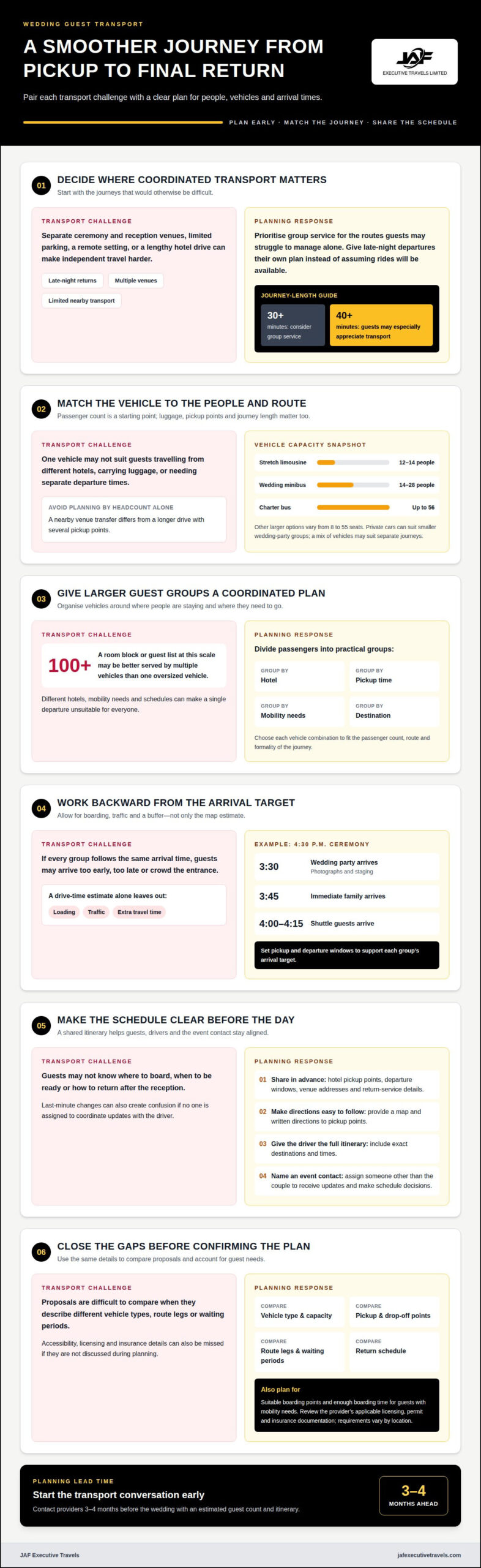
- Arrange guest transport when distances between venues, limited parking, or a remote location could make independent travel difficult. Plan late-night returns rather than assuming rides will be available.
- Match vehicles to passenger numbers, luggage, and the route; larger guest groups may need a coordinated plan using multiple vehicles.
- Work backward from arrival times, allowing for boarding, traffic, and a buffer. Share pickup points, departure windows, and return details with guests in advance.
- Start planning early: the article recommends contacting transport providers 3-4 months before the wedding with an estimated guest count and itinerary.
1. Should You Provide Transportation for Wedding Guests?
You don’t need to arrange a private ride for every guest or wedding event. A shuttle is especially useful when the ceremony and reception are at separate venues, parking is limited, or the drive from guest hotels is lengthy. For journeys beyond 30 minutes, consider a group service; guests may particularly appreciate transport when the drive exceeds 40 minutes. Well-planned transport logistics for wedding party guests begin with the journeys that would otherwise be difficult.
A transport professional can plan hotel pickups by grouping guests around their accommodation and setting a clear departure window. For a hotel-to-venue route, the itinerary should include the pickup point, boarding time, destination, and arrival target. For weddings with more than 100 guests, arrange transport well in advance and plan capacity across vehicles. This gives transport logistics for wedding party guests a clear route and passenger plan.
Late-night coordination needs its own schedule. A professional can plan separate return departures for guests leaving after dinner and those staying through the final toast. For an after-party at another venue, include that stop and the final hotel return in the itinerary, rather than assuming rides will be available late at night.
To compare professional shuttle proposals, assess the same details for each: vehicle type, passenger capacity, pickup and drop-off locations, route legs, waiting periods, and return schedule. Contact providers 3-4 months before the wedding with an estimated guest count and itinerary. A clear, shared scope makes the options easier to compare.
Passenger transport providers must meet the licensing, permit, and insurance requirements that apply where they operate. These requirements vary by location, so review the provider’s relevant documentation before confirming arrangements.
For guests with mobility needs, plan suitable boarding points, accessible vehicle arrangements, and enough time to board. Share those needs during planning so they can be taken into account when choosing vehicles and setting the itinerary.
Rural venues may require longer routes, designated hotel pickups, and planned return departures because nearby transport options can be limited. For a destination wedding, coordinate accommodation, arrival points, venue transfers, and after-party returns as one itinerary.
2. Vehicle selection by passenger capacity and trip requirements
Choose transport based on passenger numbers, luggage, route, and destination. Match each vehicle to the group’s needs, pickup points, and arrival time. Private cars suit smaller wedding-party groups, while minibuses or coaches can carry guests together. A mix of vehicles may work best for groups making separate journeys.
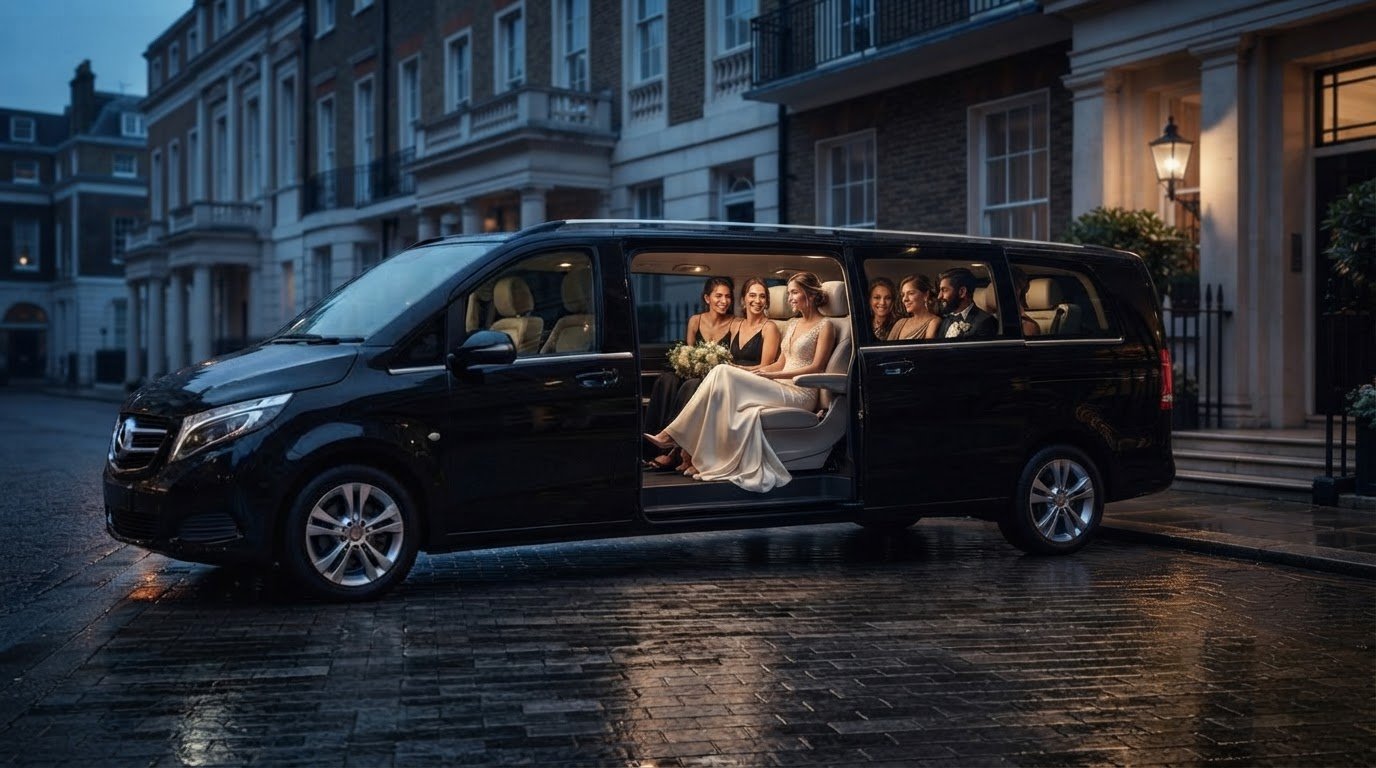
Capacity gives the plan a practical starting point. Wedding-party transport may need seating for 8 to 20 people, depending on the number of attendants. Stretch limousines can fit 12 to 14 people, while wedding minibuses usually accommodate 14 to 28 passengers. Larger options vary, with commonly offered capacities from 8 to 55 seats.
For a room block with 100-plus guests, a multi-vehicle plan may be preferable to relying on one oversized vehicle. A transport professional can divide passengers by hotel, pickup time, mobility needs, or destination, then match each group to a suitable vehicle. This also helps avoid planning around a single departure when guests have different schedules.
Consider the journey as well as the headcount. A short transfer between nearby venues has different requirements from a longer drive with luggage or several pickup points. Alternatives can include a trolley, school bus, decorated golf carts, ferry, or catamaran, depending on the route and setting. Charter buses can transport up to 56 guests.
Rideshares and taxis can be less predictable for a coordinated group, particularly after a reception or at a rural venue. Guests may arrive in separate vehicles, wait different lengths of time for pickups, or find it difficult to leave together. A reserved group plan sets out the vehicles and departure arrangements, while individual rides may still suit guests travelling independently.
For a tailored vehicle plan, a wedding chauffeur service can coordinate private journeys for the wedding party alongside group transport for guests. Choose the combination that fits the passenger count, route, and formality of each journey.
3. Creating and sharing a transportation schedule
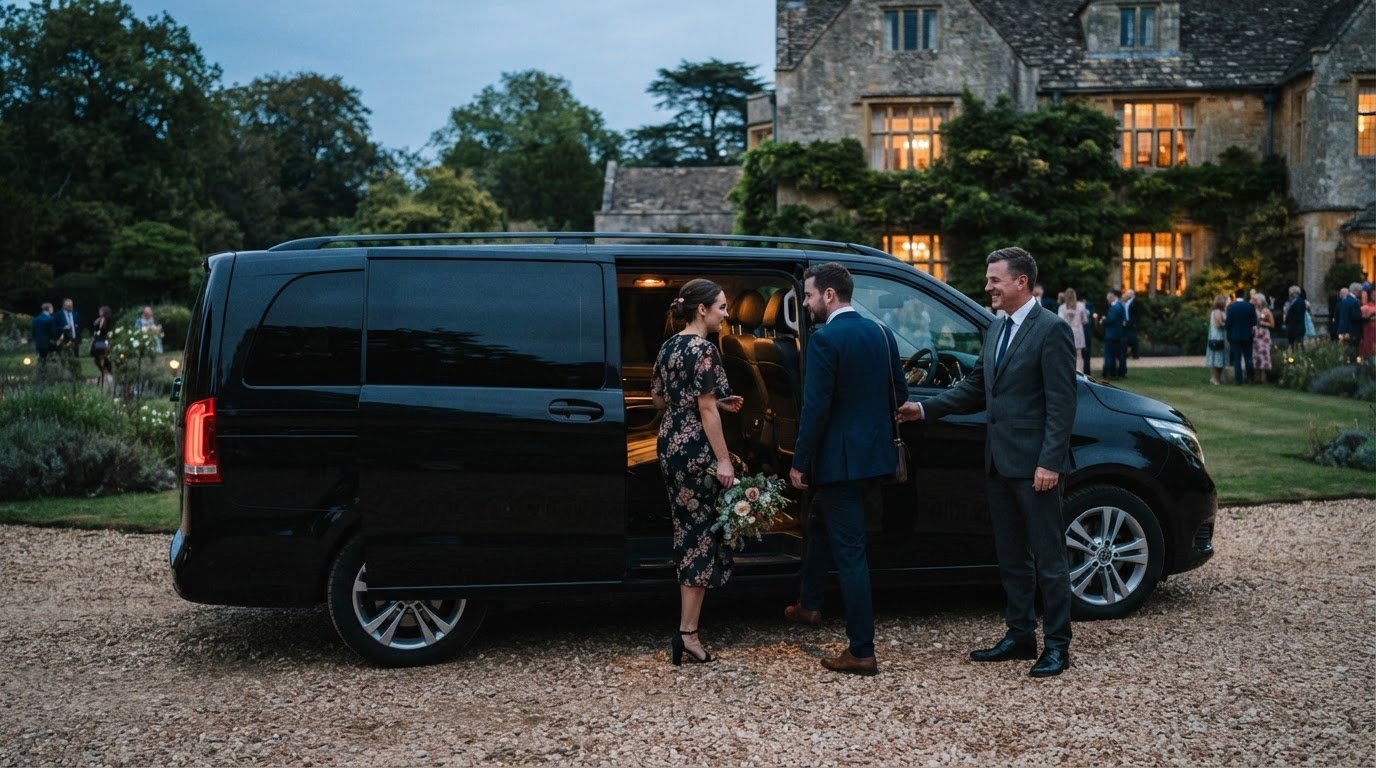
A professional works backward from each arrival target, allowing time for loading, traffic, and a buffer. For a 4:30 p.m. ceremony, the wedding party may need to arrive by 3:30 p.m. for photographs and staging. Immediate family may be asked to arrive by 3:45 p.m., while shuttle guests can arrive between 4:00 and 4:15 p.m. Guests should know the pickup time, boarding point, and vehicle departure window.
Pickup and drop-off times should follow each group’s arrival target. For example, guests can be told to board at 4:15 p.m. for a 4:30 p.m. departure. A professional accounts for the drive, boarding, and extra travel time beyond a map estimate. For a larger celebration, staggered pickups can keep arrivals flowing and prevent crowding at the entrance.
Share the timeline before the wedding through the wedding website or a guest email. Include hotel pickup locations, departure windows, venue addresses, and return-service details. A map and written directions can help guests find each pickup point. Give the transport provider the complete itinerary, including exact destinations and times for drivers.
Event-day changes need a clear point of contact. Assign someone other than the couple to receive updates and make schedule decisions, then keep that person in touch with the driver. If photographs run late or traffic affects arrival, this contact can relay revised timing without interrupting the couple’s celebration. A 15-minute window around the published ceremony start can also account for delays.
Plan evening returns around when guests expect to leave, rather than relying on one departure for everyone. For example, an early vehicle could leave at 9:30 p.m., while a later return at 11:00 p.m. serves guests staying through the final toast. Share both times in advance, including the return pickup point, so guests can choose the departure that suits them.
4. Wedding-party and guest group transportation
Couples can plan separate journeys for the wedding party, family members, and other guests. A professional maps each group’s route from pickup through ceremony arrival, reception transfer, and return. This creates one coordinated travel plan while allowing different vehicles or departure times for distinct needs.
During wedding planning, use the online RSVP form to ask guests whether they need transport. Responses help estimate the number of seats and identify hotel clusters, while the itinerary can account for guests travelling independently. Include nearby airports or train stations in guest information, along with practical details about public transport and access to the venue.
For a hotel block, set return departure times so guests know when to board and the transport provider can coordinate pickups. Using one transport company for both venue legs can help guests move between locations without changing vehicles. If the ceremony and reception are separate, list both destinations and allow time for the transfer in the group itinerary.
Keep group transport focused on journeys where coordination matters most. A shared ride may be especially useful when parking is limited, traffic could delay arrivals, or guests need to travel between venues. For shorter trips of 20 minutes or less, individual rideshares may be an option, while planned group departures suit guests who prefer a coordinated journey.
You don’t need to provide private transport for every event or guest. Even if you arrange only one direction, a ride to the ceremony can give guests a reliable way to arrive. Make the plan clear in advance: state who the service is for, where it departs, and which destinations it serves. This helps prevent family members and guests from assuming different arrangements.
For wedding-party journeys that call for a private, tailored itinerary, arrange coordinated wedding transport around your event schedule and guest groups.
JAF Executive Travels: Wedding Chauffeur Service
JAF Executive Travels provides a Wedding Chauffeur Service for couples seeking polished, private travel for the wedding party. Choose a Mercedes-Benz S-Class, V-Class, or E-Class Chauffeur Service to suit the journeys in your itinerary. Professional chauffeurs can follow a tailored schedule for key wedding-day transfers, helping coordinate arrivals and transitions.
Wedding chauffeur packages range from four-hour bookings to full-day event management. This can suit plans focused on selected transfers or a longer schedule involving several wedding-day movements. Share your itinerary and the journeys you want covered to shape the arrangement around the celebration.
For private wedding-party travel, contact JAF Executive Travels to discuss your Wedding Chauffeur Service.
Set the tone for a gracious arrival
As you move from planning to final arrangements, consider the experience you want guests to have while travelling. Thoughtful transport logistics for wedding party guests can make the journey feel like a considered part of the celebration, not just a transfer between addresses. A clear, polished travel plan also leaves you more room to focus on the people and moments that matter most.
For private wedding-party journeys, JAF Executive Travels offers Mercedes-Benz S-Class, V-Class, and E-Class Chauffeur Services. These vehicles can support tailored arrangements for key members of the wedding party, with the choice guided by each journey. Choose the service that suits your day and the experience you want to create.
If you’re ready to plan your wedding transport, contact JAF Executive Travels to discuss your requirements. With a considered plan in place, you can look forward to a more composed and memorable celebration.
Frequently Asked Questions
How Far Ahead Should You Reserve?
Reserve once your venue and hotel block are confirmed, particularly for spring and fall weddings. Contact transport providers 3-4 months before the date with an estimated guest count. This gives the planning conversation a clear foundation. If your event has several locations or a destination schedule, prepare the route sequence early so the proposed arrangements reflect the full day.
Should You Provide Transportation for Wedding Guests?
Not necessarily for every guest or event. Group transport is most useful when guests need to travel between separate venues, parking is limited, or independent travel is difficult. If accommodation, the ceremony, and the reception are close together, guests may have other convenient ways to get around. Identify who needs support, then arrange transport for those journeys rather than booking rides without a clear purpose.
How is wedding guest transportation planned?
The transport arrangement is shaped by the number of passengers, journey distance, vehicle combination, and stops in the itinerary. For example, guests travelling together from one hotel may be planned as a group, while the wedding party may need separate journeys. Return trips and different departure times also affect how seats are assigned. These details help define the transport plan for your event.
How does a professional arrange transportation between the ceremony, reception, and hotels?
Organize journeys as connected route segments instead of treating each transfer separately. Identify which guests travel from each hotel, whether the ceremony-to-reception journey needs separate vehicles, and where guests board after the event. Share one coordinated itinerary with drivers so addresses, passenger groups, and planned stops stay aligned throughout the day.
What should a wedding transportation contract with a provider include?
Ask for a written agreement that records the booked vehicle types, passenger capacity, pickup and drop-off addresses, service times, planned stops, and return arrangements. It should also explain the terms for changes, cancellations, waiting time, and additional services. Confirm that accessibility needs and the named event-day contact are included, so responsibilities are clear to everyone involved.
How far in advance should wedding transportation be booked?
Begin booking discussions 3-4 months before the wedding, and secure arrangements once your venue and accommodation plans are settled. After booking, provide the provider with the full itinerary and exact destinations early. Share final timing or route changes shortly before the event, so the operating plan reflects the latest details rather than an earlier draft.

Tom Copper
Tom Copper is a UK-based travel and tourism writer with a deep passion for transforming journeys into compelling stories. Over the years, he has explored both iconic destinations and lesser-known hidden gems, always seeking experiences that create meaningful connections between people and places. His writing reflects a genuine appreciation for culture, history, and adventure, blending practical travel advice with thoughtful personal insights. From vibrant city breaks and scenic coastal escapes to peaceful countryside retreats, Tom shares travel inspiration that feels authentic, relatable, and exciting. When he’s not crafting his next article, you’ll likely find him wandering through local markets, sampling new cuisines, or capturing unique moments through his camera lens. For Tom, travel is never just about ticking destinations off a list—it’s about the stories, emotions, and memories created along the way.
Chauffeur Service for Multi-Day Asian Wedding Guest Travel in the UK
Guest transport can be planned across the celebrations, not just for the ceremony. A chauffeur…
Plan Who Rides and How the Groom and Groomsmen Get There
A polished arrival begins well before the wedding day. For transport for the groom and…
Mercedes V-Class Bridal Party Transport for Larger Groups
A Mercedes V-Class can bring bridal-party members or family together in one comfortable vehicle. Wedding…

Professional Female Chauffeur London: Pricing and Bookings
Yes, long-distance journeys can be arranged with a professional female chauffeur in London, not just…
Transport logistics for wedding party guests: Planning guest rides
The guest-transport decision is not simply whether to book a shuttle; timing matters too. Begin…
Chauffeur for Landmark Wedding Proposal: Pickup Planning
A landmark may set the scene, but carefully planned travel helps the proposal feel calm…
Chauffeur Driven Mercedes V-Class Cost and Service
A smooth journey starts with clear arrangements, from pickup point to destination. A chauffeur-driven Mercedes…

Chauffeur Driven Day Trip to Bath from London
Does a chauffeur act as your guide inside Bath’s historic attractions? The chauffeur’s role is…

Long Distance Chauffeur Service in the UK: Compare Travel Options
The fastest option isn’t always the most comfortable for a long UK journey. A long-distance…
Chauffeur for Medical Appointments in Harley Street with Waiting
Ask whether waiting can be included in your booking for a Harley Street appointment. A…