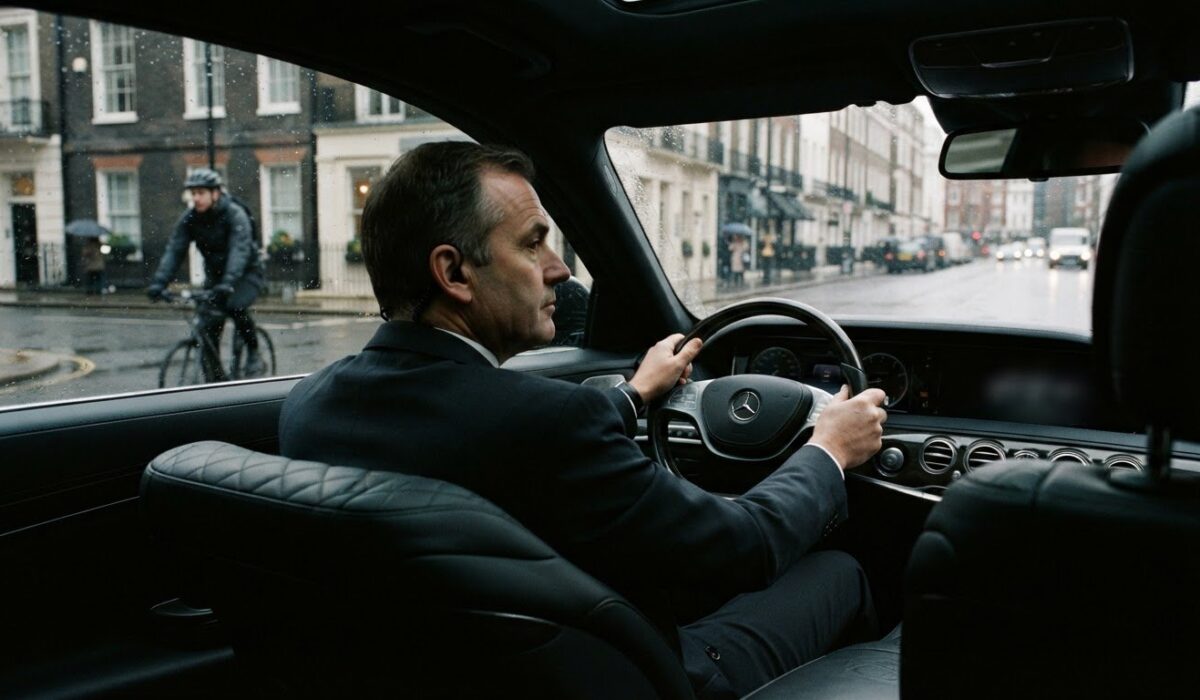
Advanced driving skill is only one part of an executive chauffeur’s value. A chauffeur with advanced driving qualifications brings a blend of higher-level vehicle-control training, the professional licence required for the work in their jurisdiction, and attentive passenger care.
Executive travel calls for more than a smooth journey: discretion, punctuality and calm, courteous communication matter too. The exact qualification varies, but advanced training can cover defensive driving, hazard awareness, vehicle handling and accident avoidance. Professional standards also include route planning and passenger care.
This guide explains what chauffeur training and certifications may include, how licensing requirements differ by location, and what executive etiquette looks like in practice. It also covers passenger care, itinerary communication and the professional approach that helps keep business travel composed and comfortable.
Key Takeaways
- Understand how advanced driving training can complement the licence required for professional chauffeuring in each jurisdiction.
- Recognise the passenger-care standards that support discreet, comfortable and well-organised executive journeys.
- Learn which driving skills and professional certifications may form part of a chauffeur’s qualifications.
- See how a tailored executive chauffeur service can bring together professional driving, suitable vehicle choice and attentive travel planning.
Customer service, etiquette, and passenger care
Executive passenger care shows in small decisions throughout a journey. A chauffeur’s greeting, luggage assistance, communication and respect for privacy shape the experience alongside driving skill. Training can cover customer service as well as practical driving, helping chauffeurs respond calmly and communicate effectively.
Before departure, confirm the itinerary, collection point and planned stops. If traffic affects arrival times or a meeting location changes, explain the adjustment clearly and promptly. A passenger travelling between appointments needs a concise update and revised arrival estimate, not a distracting stream of messages. Clear communication helps the passenger manage their schedule while the chauffeur focuses on the road.
Etiquette also means responding to the passenger’s preferences. A polite introduction and brief confirmation of the destination establish a professional tone. Then let the passenger choose conversation or quiet. An executive preparing for a presentation may value privacy, while a visitor unfamiliar with the area may welcome a concise local recommendation. Good service responds to these cues without becoming intrusive.
Punctuality depends on preparation as well as driving. Review the route and collection details before setting out, then remain composed if congestion or a road incident disrupts the plan. A professional chauffeur explains the next steps and adapts the route safely. A calm manner matters: hurried conversation or visible frustration can add stress when a passenger already faces a tight schedule.
- Protect privacy: Keep business conversations discreet and avoid repeating personal details in public.
- Make comfort practical: Offer assistance with luggage and ask before adjusting cabin preferences.
- Communicate selectively: Share relevant itinerary changes, while leaving uninterrupted work time when requested.
Passenger care can also include thoughtful amenities. Bottled water, an umbrella, USB ports or a light snack can help address practical needs during a journey. Their value depends on timing: an umbrella is useful at a wet arrival, while a charging point can support a passenger preparing for a call. The chauffeur should offer assistance courteously rather than assume every guest wants the same service.
Local knowledge adds another layer of attentiveness. A chauffeur who knows the area can anticipate a one-way system, identify a suitable drop-off point or suggest a nearby landmark when asked. This is especially useful for visitors attending meetings across an unfamiliar city. Driving instruction can teach road skills, but executive etiquette shows in how those skills serve the passenger, from the first greeting to arrival.
When comparing providers, check reputations for punctuality and ask whether bottled water or in-vehicle bars are available; choose a chauffeur who stays calm and confident through traffic problems.
Professional driving licences and certifications
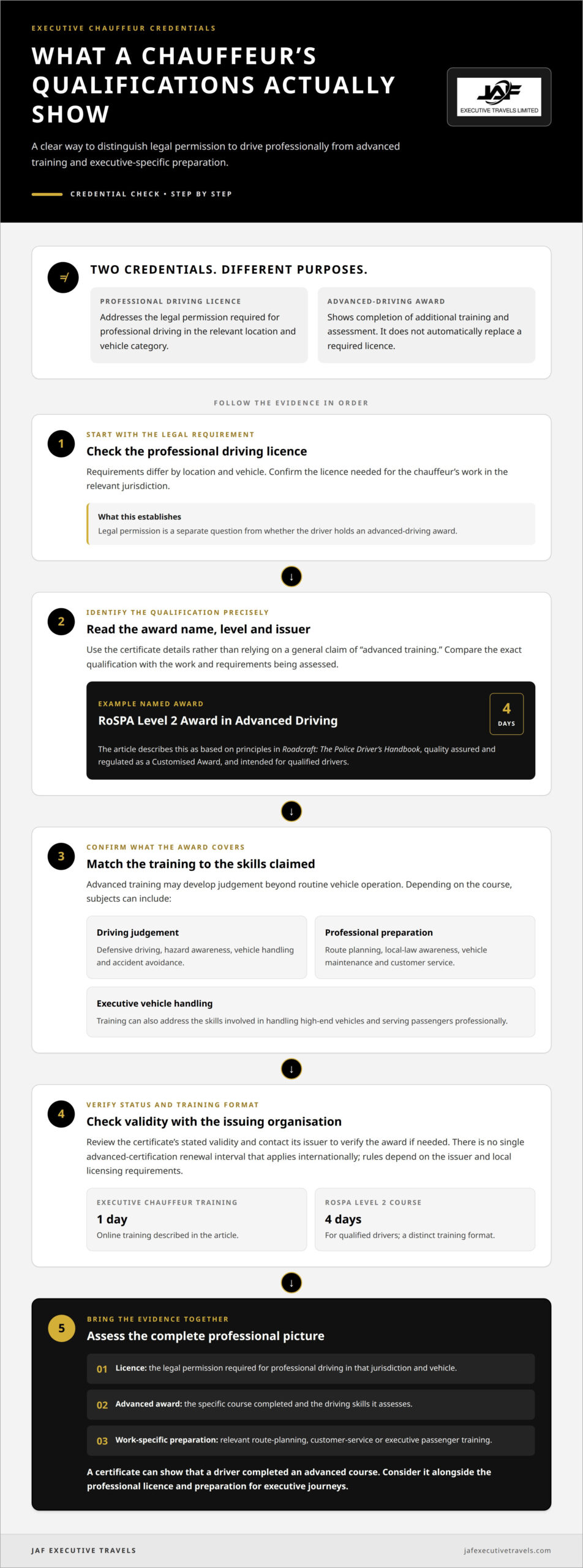
Professional credentials combine legal permission to drive for work with training that develops judgement beyond routine vehicle operation. Requirements vary by location and vehicle, so distinguish a required licence from an advanced-driving award.
Qualification Scope
An advanced driving qualification assesses how a driver observes hazards, controls a vehicle and makes decisions in changing conditions. The RoSPA Level 2 Award in Advanced Driving is based on principles in Roadcraft: The Police Driver’s Handbook. According to RoSPA Qualifications, it is quality assured and regulated as a Customised Award, and its four-day course is for qualified drivers.
Advanced driving qualifications usually supplement, rather than replace, the valid driver’s licence needed for professional driving. Whether a chauffeur-specific or commercial licence is also required depends on the vehicle and local rules. An advanced award does not automatically change those requirements.
Training can develop defensive driving, route planning, local-law awareness, vehicle maintenance and skills for handling high-end vehicles. These subjects connect technical driving with the judgement and passenger service expected of professionals. Some corporate transportation contracts also require chauffeur certification as a minimum qualification.
Credential Verification
To assess credentials, identify the exact award name, level and issuing organisation on the certificate. Compare those details with the chauffeur’s professional driving licence and the requirements for the relevant jurisdiction and vehicle. This helps distinguish an advanced-driving certificate from legal permission to drive professionally.
For example, a RoSPA Level 2 Award is a named qualification, while the driver’s licence addresses a separate requirement. Check the certificate’s stated validity and contact its issuing organisation to verify the award if needed. A clear record of both credentials gives you a more useful picture than a general claim of advanced training.
How often must advanced driving certifications be renewed? There is no single renewal interval that applies internationally. Renewal or continuing-validity rules depend on the qualification issuer and applicable local licensing requirements.
Some training is designed specifically for executive passenger work. The research describes one day of online Executive Chauffeur Training, alongside the four-day RoSPA Level 2 course for qualified drivers. These are distinct training formats, so the course title and certificate help clarify what a chauffeur has completed.
For a well-grounded assessment, consider the qualification, professional licence and work-specific training together. A certificate can show that a driver completed an advanced course; route-planning and customer-service training can indicate preparation for executive journeys. This distinction makes credential checks more meaningful and clarifies what the chauffeur’s qualifications demonstrate.
What is an advanced driving qualification for a chauffeur?
An advanced driving qualification is structured training that develops a chauffeur’s vehicle control, hazard awareness and decision-making. It goes beyond routine driving by practising how to respond smoothly when road conditions change. For an executive passenger, that can mean a measured approach to traffic, precise manoeuvres and fewer abrupt movements.
One framework used in advanced driver training is IPSGA: Information, Position, Speed, Gear and Accelerate. It gives drivers a sequence for reading the road and planning a response. Before a bend, for example, a driver gathers information, chooses a suitable position, adjusts speed, selects gear and accelerates when appropriate. The sequence supports deliberate decisions rather than last-second reactions.
Practical training can include several distinct vehicle-control skills:
- Braking and cornering: Manage speed and direction with smooth, controlled inputs.
- Acceleration and handling: Maintain measured control as traffic or road conditions change.
- Emergency lane changes and accident avoidance: Practise responding to a developing hazard.
- Emergency backing and point turns: Build control during restricted-space manoeuvres.
These exercises focus on anticipation as well as technique. A chauffeur approaching a sudden obstruction needs to assess surrounding traffic before choosing a safe response. Emergency manoeuvres are training scenarios, not a reason to take unnecessary risks on public roads. Their purpose is to build understanding of vehicle response and sound judgement.
Advanced training may also address defensive driving, route planning, local laws, vehicle maintenance and handling high-end vehicles. These subjects extend beyond manoeuvring: a chauffeur must understand how preparation and vehicle care support a composed passenger journey. For an electric or hybrid vehicle, knowledge of charging infrastructure and range management can also be important.
A certificate describes completed training, but its value lies in the skills it assesses. Consider whether its scope covers both vehicle control and the demands of professional passenger travel. A programme centred on emergency manoeuvres differs from one that also includes defensive driving and route planning. This distinction helps clarify what a chauffeur’s advanced preparation represents.
For executive travel, the practical standard is calm, anticipatory driving that leaves passengers free to focus on their priorities. A chauffeur with advanced driving qualifications can bring formal training to that responsibility, while professional etiquette and licensing remain separate parts of the overall standard.
At JAF Executive Travels, professional training ensures passengers experience a smoother journey. Students learn braking, cornering, proper acceleration, vehicle handling, emergency lane changes, emergency backing, accident avoidance, and effective point turns. These skills reinforce disciplined control in demanding situations.
JAF Executive Travels
JAF Executive Travels arranges executive travel around your itinerary, passenger needs and preferred vehicle. If you’re weighing professional driving standards alongside comfort and discretion, share the journey details and priorities that matter most, such as a quiet cabin or space for colleagues to travel together.
Choose the Mercedes-Benz S-Class, E-Class or V-Class Chauffeur Service, or the Range Rover Autobiography Chauffeur Service. Each offers a different setting for your travel plans, from individual executive journeys to group travel. The right option depends on your itinerary, passengers and luggage, so consider those practical details when planning.
For a tailored executive journey, contact JAF Executive Travels to discuss your requirements.
Plan Your Next Executive Journey
Make your next journey easier to plan by setting out its purpose, schedule and passenger preferences before booking. If you’re considering a chauffeur with advanced driving qualifications, include that preference in your travel brief alongside practical details such as collection arrangements and planned stops. A clear brief helps align the journey with the way you need to work and travel.
JAF Executive Travels can turn those requirements into a considered travel plan. Share what matters for your day, from timing to privacy, and discuss an arrangement suited to your itinerary.
For a composed start to your travel planning, Contact JAF Executive Travels.
Frequently Asked Questions
What’s included?
A training course’s inclusions depend on its syllabus and may cover instruction, practical exercises, assessment and a completion record. For executive travel, distinguish course content from the booked journey’s arrangements. A useful brief can specify collection access, passenger numbers, luggage and schedule constraints, so the travel plan reflects actual requirements rather than assumptions about what training includes.
How can a client confirm that a chauffeur has earned an advanced driving qualification?
Ask the chauffeur or operator for permission to validate the credential with its issuing organisation. The issuer can explain how it authenticates completion records and whether the qualification remains current. For a corporate booking, record the outcome alongside the supplier’s other onboarding documents. This creates a clear audit trail without relying solely on verbal assurance or an unfamiliar certificate design.
What is the difference between defensive driving and advanced driving qualifications?
Defensive driving describes an approach to reducing road risk; an advanced driving qualification is evidence of completing a defined learning programme. A driver may apply defensive judgement during a routine journey without holding a particular award. Conversely, a certificate documents course achievement, while the driver’s conduct on an individual trip depends on decisions and conditions at the time.
What advanced driving skills are covered, such as skid control or evasive driving?
Course coverage varies, so don’t assume a qualification includes skid control or evasive driving based on its title alone. If either skill matters for an assignment, ask to see the syllabus and check whether it is taught and assessed. Course descriptions can distinguish classroom discussion from supervised practical instruction, clarifying what the chauffeur has practised.
Do advanced driving certifications improve chauffeur pay or job prospects?
They may improve job prospects because some corporate transportation contracts require chauffeur certification as a minimum qualification.

Tom Copper
Tom Copper is a UK-based travel and tourism writer with a deep passion for transforming journeys into compelling stories. Over the years, he has explored both iconic destinations and lesser-known hidden gems, always seeking experiences that create meaningful connections between people and places. His writing reflects a genuine appreciation for culture, history, and adventure, blending practical travel advice with thoughtful personal insights. From vibrant city breaks and scenic coastal escapes to peaceful countryside retreats, Tom shares travel inspiration that feels authentic, relatable, and exciting. When he’s not crafting his next article, you’ll likely find him wandering through local markets, sampling new cuisines, or capturing unique moments through his camera lens. For Tom, travel is never just about ticking destinations off a list—it’s about the stories, emotions, and memories created along the way.
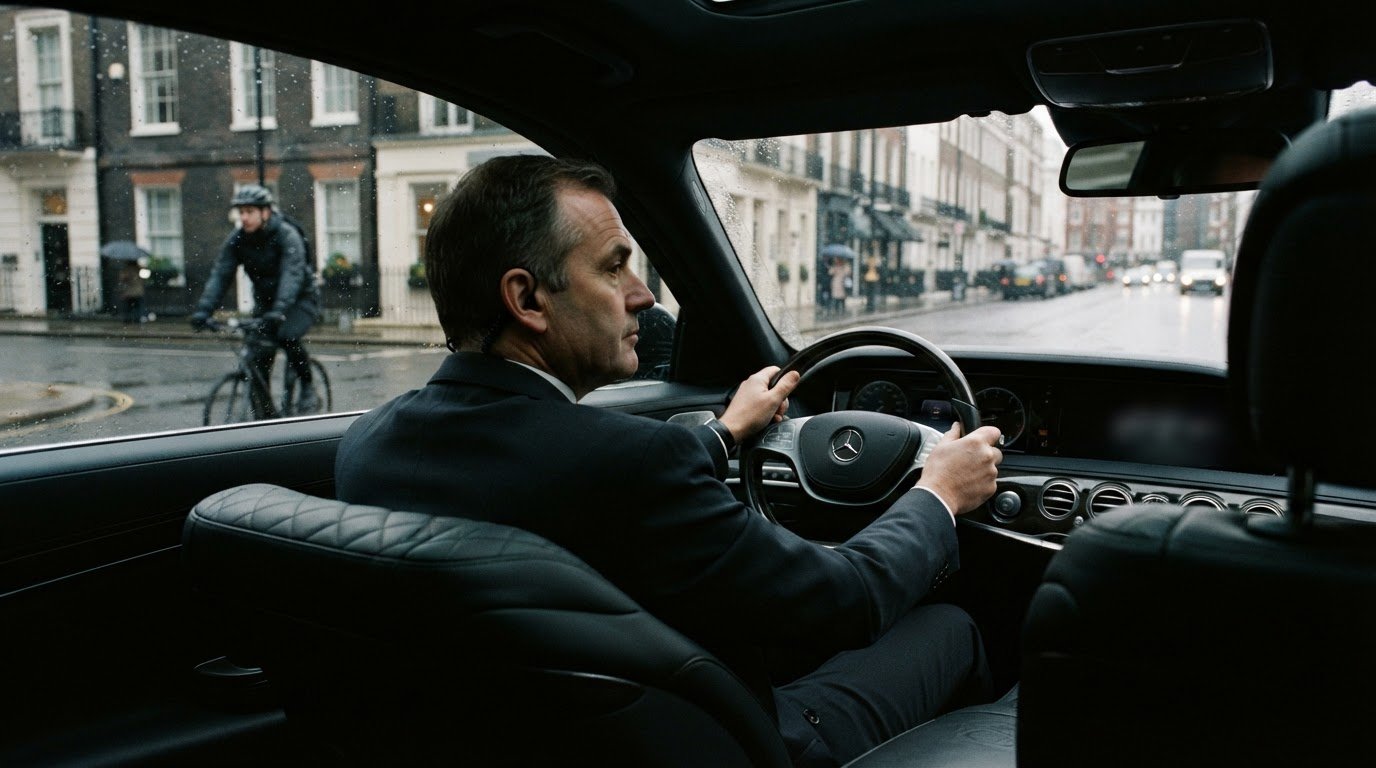
Chauffeur with advanced driving qualifications for executives
Advanced driving skill is only one part of an executive chauffeur’s value. A chauffeur with…
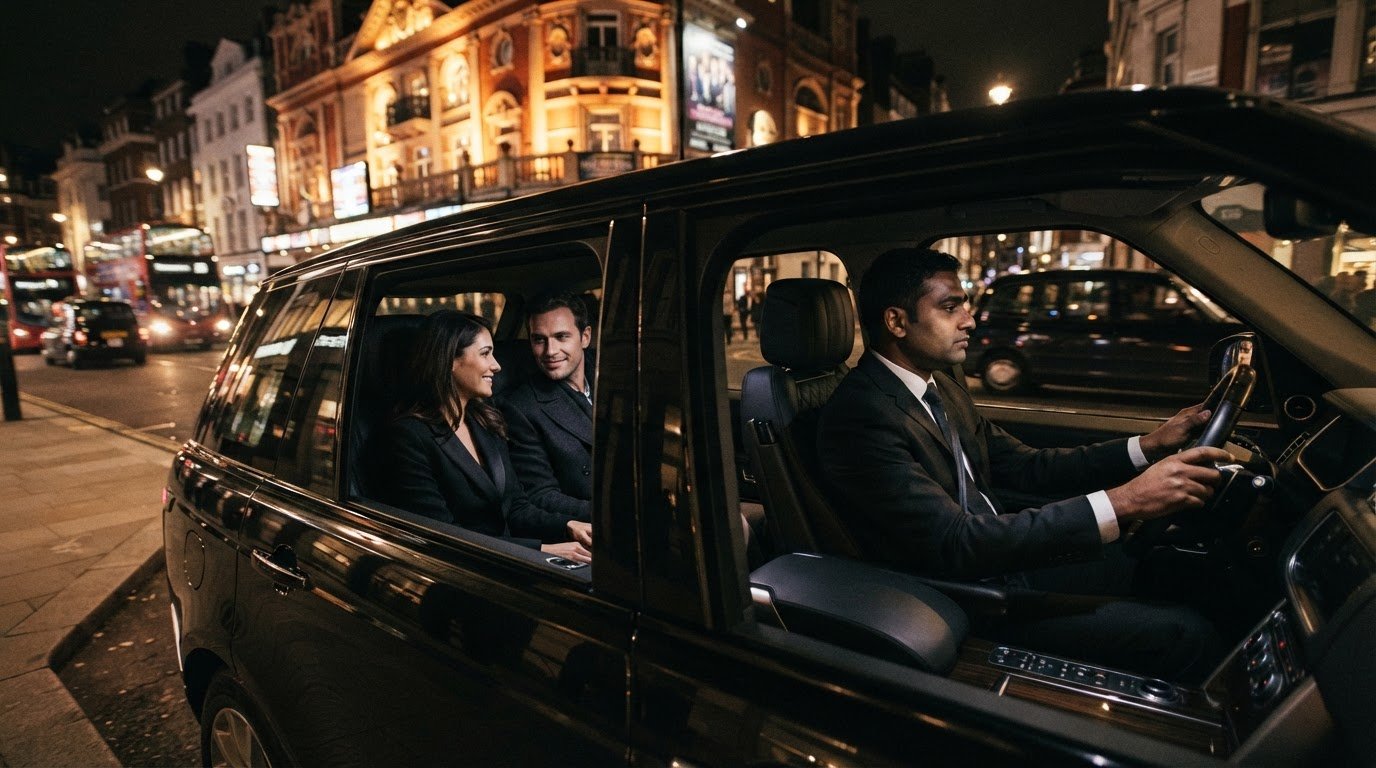
Door-to-door chauffeur service for London theatre nights
A West End performance should be the evening’s main event, not the journey there and…
Chauffeur Service for Multi-Day Asian Wedding Guest Travel in the UK
Guest transport can be planned across the celebrations, not just for the ceremony. A chauffeur…
Plan Who Rides and How the Groom and Groomsmen Get There
A polished arrival begins well before the wedding day. For transport for the groom and…
Mercedes V-Class Bridal Party Transport for Larger Groups
A Mercedes V-Class can bring bridal-party members or family together in one comfortable vehicle. Wedding…
Professional Female Chauffeur London: Pricing and Bookings
Yes, long-distance journeys can be arranged with a professional female chauffeur in London, not just…
Transport logistics for wedding party guests: Planning guest rides
The guest-transport decision is not simply whether to book a shuttle; timing matters too. Begin…
Chauffeur for Landmark Wedding Proposal: Pickup Planning
A landmark may set the scene, but carefully planned travel helps the proposal feel calm…
Chauffeur Driven Mercedes V-Class Cost and Service
A smooth journey starts with clear arrangements, from pickup point to destination. A chauffeur-driven Mercedes…