Orientation is a starting point, not the whole standard. Whether chauffeurs receive ongoing training depends on the operator, but a professional approach treats initial screening and qualification as the foundation for continued attention to driving, service and passenger needs. A thorough vetting and training process for professional chauffeurs helps shape the calm, dependable experience you expect.
It’s reasonable to look beyond a polished introduction: safety, discretion and punctuality rely on more than first impressions. This article explains how screening, driving qualifications and credential checks fit together, and why professional development can matter beyond initial orientation.
You’ll also learn what professional service standards look like in practice, from smooth driving and route planning to considerate passenger care. Together, these elements help create a composed, tailored and reassuring journey from pickup to arrival.
Key Takeaways
- Learn which screening areas can help assess a chauffeur’s suitability, including driving history, criminal history and medical fitness.
- See how continued training and performance reviews can reinforce professional standards beyond initial orientation.
- Recognize how discretion, polished conduct and attentive communication shape a reassuring passenger experience.
- Understand why licensing and credential requirements vary by location and why they matter for the vehicles a chauffeur operates.
Background checks and chauffeur qualifications
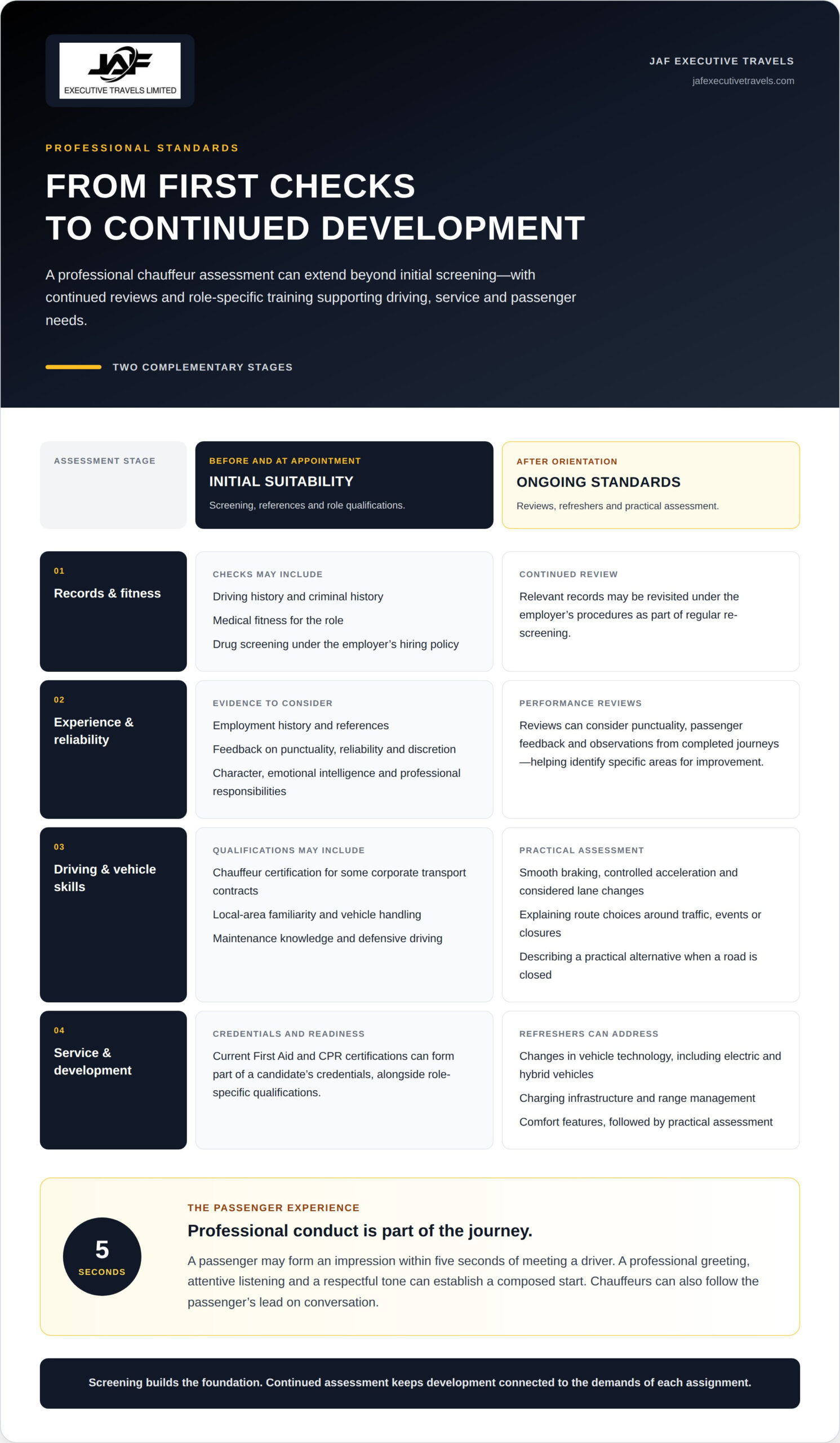
Professional chauffeur companies commonly review driving records, criminal history and medical fitness. The vetting and training process for professional chauffeurs can also include references and role-specific qualifications, helping employers assess how candidates handle vehicles, passengers and private information.
Employment and Reference Checks
Employment and reference checks verify a candidate’s work history and provide insight from previous employers. They matter because punctuality, reliability and discretion are shown through conduct, not driving skills alone. References can speak to a candidate’s character, emotional intelligence and professional responsibilities. Comparing those accounts with employment history can reveal gaps or conflicting details that merit closer review.
Qualifications help complete the picture. Corporate transport contracts may require chauffeur certification, while employers may also assess local-area familiarity, vehicle handling and maintenance knowledge. Defensive driving skills support smooth, considered decisions. Current First Aid and CPR certifications can also form part of a candidate’s credentials. Together, these factors help show how prepared someone is for the role.
Drug and Criminal Record Screening
Drug screening checks for substance use under an employer’s hiring policy, while criminal-record checks review relevant records. These are distinct checks, not substitutes for driving-history or reference reviews. The vetting and training process for professional chauffeurs should treat them as parts of a wider assessment. For passengers, careful screening supports confidence in the person entrusted with their journey and privacy.
Medical examinations and driving-record reviews add context to a candidate’s suitability. A driving record helps employers assess a person’s history behind the wheel, while an examination addresses fitness for the role’s demands. Consider these alongside verified references, qualifications and vehicle-handling skills. Together, the checks support a balanced assessment of professional conduct and readiness, rather than relying on a single measure.
Do chauffeurs receive ongoing training after orientation?
Yes. Professional development can continue after orientation through scheduled reviews and role-specific refreshers. Ongoing assessment helps keep a chauffeur’s driving and service skills aligned with the demands of each assignment.
Annual Re-Screening and Performance Reviews
Regular re-screening and performance reviews provide opportunities to assess conduct and work standards. Reviews can consider punctuality, passenger feedback and observations from completed journeys. These checkpoints help identify specific areas for improvement instead of relying on a single initial assessment.
For example, recurring feedback about abrupt turns can lead to a focused review of cornering and passenger comfort. Re-screening can also revisit relevant records under the employer’s procedures. Together, these measures help maintain professional standards over time.
Driving Skills and Local Route Knowledge
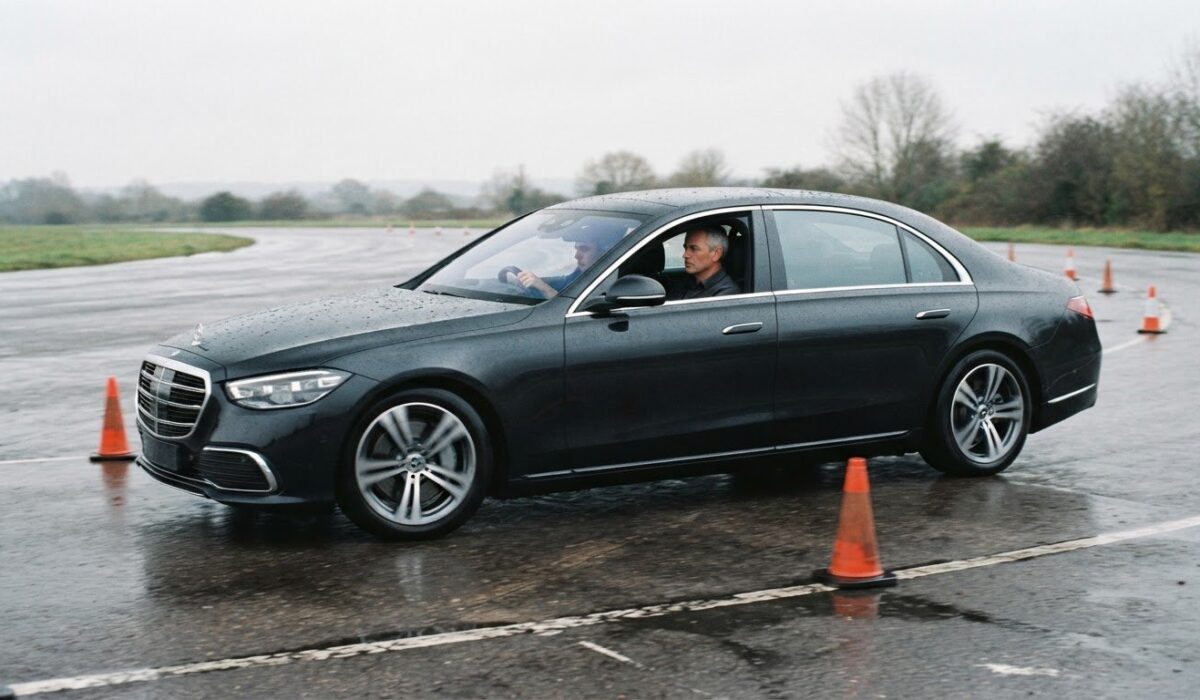
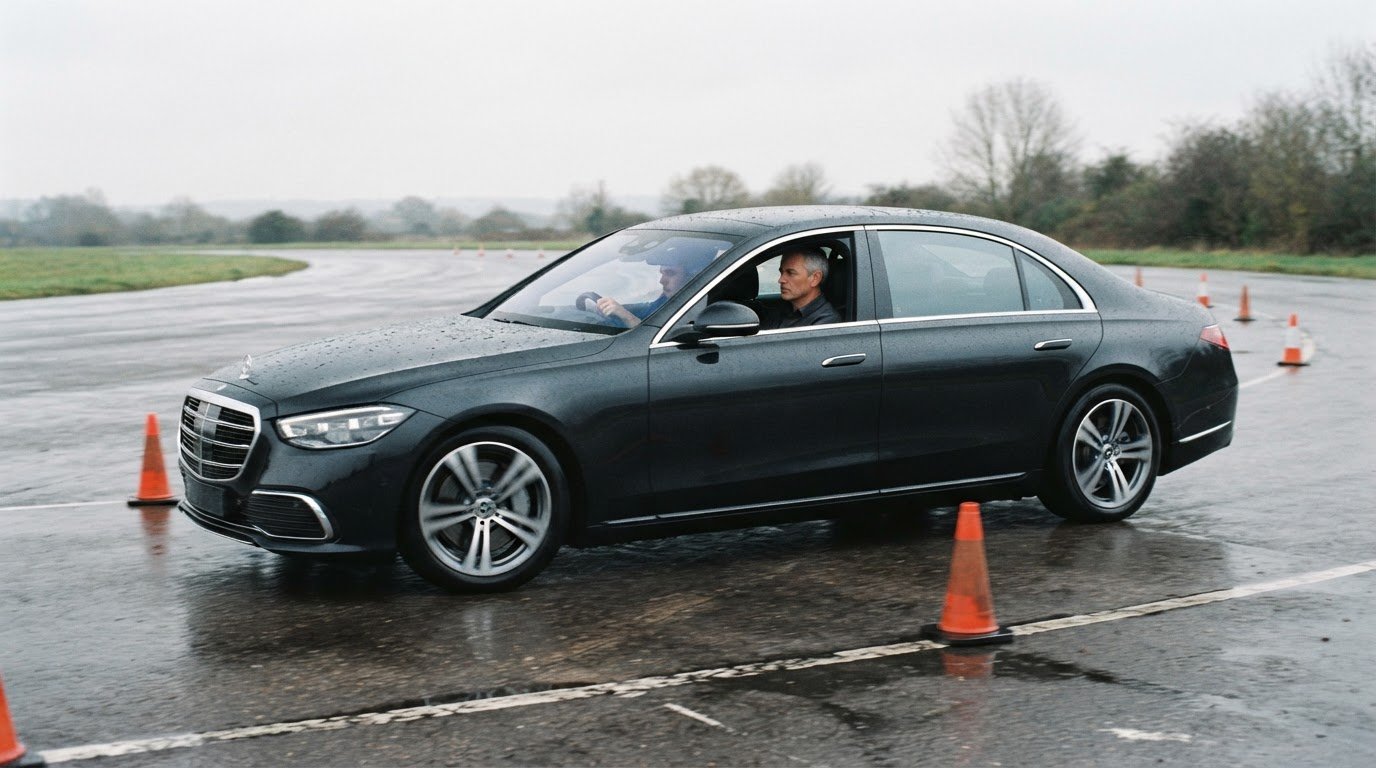
Driving skills can be assessed by observing smooth braking, controlled acceleration and considered lane changes. Assessors can also ask chauffeurs to explain route choices using local traffic patterns, planned events, closures and alternative roads. This shows how they combine driving judgement with preparation.
For your journey, route knowledge matters when a disruption affects the planned itinerary. An assessment might present a road closure and ask the chauffeur to describe a practical alternative. The evaluator can then consider whether the decision supports efficient travel without compromising a composed passenger experience.
Ongoing Training and Certification
Refresher training can respond to review findings and changes in vehicle technology. As certification programmes adapt to electric and hybrid luxury cars, training may cover charging infrastructure and range management. These subjects help chauffeurs understand operational considerations relevant to the vehicles they drive.
Training plans reflect course content, the chauffeur’s responsibilities and identified development needs. A session might focus on using climate controls, seating configurations or onboard comfort features smoothly. Follow-up assessment can establish whether the chauffeur applies that learning during a practical journey, keeping development connected to passenger needs.
Customer service, cultural sensitivity, and VIP protocol
Chauffeurs learn customer service, etiquette and privacy through instruction and practical scenarios. Training helps drivers adapt their communication and conduct to each passenger, whether the journey involves an airport pickup or corporate travel.
Customer Service and Cultural Sensitivity
Customer service and cultural sensitivity training teaches chauffeurs to respond thoughtfully to different passenger preferences. It matters because a passenger may form an impression within five seconds of meeting a driver. A professional greeting, attentive listening and a respectful tone establish a composed start. For example, a chauffeur can follow a passenger’s lead on conversation rather than assuming they want to talk.
Executive Etiquette and Behavioral Protocols
Executive etiquette defines the conduct expected during professional journeys, including presentation, posture and communication. Impeccable attire, appropriate body language and personal hygiene are core parts of a chauffeur’s professional presence. These details help create a polished experience for an executive without drawing unnecessary attention. Training can use scenarios such as greeting a guest, assisting with luggage, or allowing a passenger to work quietly.
Corporate and resort protocols can differ, so chauffeurs need to follow the instructions for each itinerary. At a corporate meeting, that may mean arriving at the agreed entrance and keeping schedule changes discreet. At a resort, it may mean coordinating pickup details with the designated reception point. Clear instructions help make each handoff efficient and suited to the setting.
Privacy is equally practical. Confidentiality protocols can guide chauffeurs to avoid discussing passenger names, destinations or conversations in public. For an airport transfer, for instance, the chauffeur can confirm the pickup discreetly and share only the details needed to complete the handoff. These habits support trust on executive, leisure and other journeys.
Insurance, licensing, and permit verification
Credential checks should match the chauffeur’s duties, vehicle and operating location. Requirements vary, and a licence or permit may not cover every assignment.
Licensing and Vehicle-Specific Certifications
Vehicle-specific credential checks confirm that a chauffeur holds the licence and certifications needed for each vehicle they may operate. Different vehicle categories can require different qualifications. Employers can compare assigned duties with the chauffeur’s credentials and record which vehicles those credentials cover. This makes operational decisions clearer and helps ensure each assignment matches the chauffeur’s documented qualifications.
License and DOT Compliance Verification
Licence verification checks that a chauffeur’s driving licence is valid for the duties and location involved. A “DOT compliance” review applies only where the relevant transport authority governs the operation. Since requirements vary by location, companies need to consider the applicable jurisdiction rather than assume one national standard applies everywhere. This keeps credential reviews relevant to the journey and operating context.
Permits and Commercial Driving Requirements
Whether a commercial driver’s licence or another permit is needed depends on the location, vehicle category and role. Chauffeur licensing requirements vary, and a valid driver’s licence is typically required. Some duties may call for additional credentials, so companies should align each assignment with the chauffeur’s documented qualifications. This distinction matters for ground transportation across different markets.
Insurance documentation should also be reviewed in context. Companies can consider whether policy documents relate to the vehicle and passenger-transport work involved. Licensing and insurance checks serve different purposes, so one should not substitute for the other. Clear records help keep both areas distinct and support orderly business operations.
For a journey arranged around your requirements, explore chauffeur travel options.
JAF Executive Travels
JAF Executive Travels offers a considered next step when you need a professional chauffeur for business or private travel. Its Mercedes-Benz S-Class, V-Class and E-Class Chauffeur Services, alongside the Range Rover Autobiography Chauffeur Service, provide options for different passenger and itinerary needs. Choose the journey around your priorities, whether that means a refined executive transfer, space for companions, or a tailored travel plan.
The screening and training standards discussed above offer useful context for understanding professional service. For your own journey, clear requirements around timing, passenger comfort and discretion help shape the right arrangement. JAF Executive Travels focuses on chauffeur-led travel, rather than self-drive hire or on-demand economy transport.
For a chauffeur journey tailored to your requirements, contact JAF Executive Travels.
Plan a Journey That Fits Your Day
Your next journey deserves a plan shaped around its purpose, not just its destination. The vetting and training process for professional chauffeurs offers a useful standard for considering the experience you want: composed service, discretion and a smooth fit with your schedule. Think about whether you need a quiet executive transfer, room for companions or flexibility across planned stops.
JAF Executive Travels offers Mercedes-Benz S-Class, Mercedes-Benz V-Class and Mercedes-Benz E-Class Chauffeur Services. These options suit different passenger requirements and travel plans, with comfort and professional service central to the experience. Share your itinerary priorities and preferred type of journey so the arrangements can reflect those details.
To discuss your travel requirements, contact JAF Executive Travels. A considered journey begins with a clear conversation.
Frequently Asked Questions
What drug testing and medical screening do chauffeur employers require?
Employers set screening procedures according to their hiring policy and the duties involved; there is no single testing package for every chauffeur role. Drug-testing procedures and the scope of a medical examination can therefore differ. A practical approach is to define the role-related checks in advance and apply the same stated criteria consistently to candidates for comparable positions.
What training do professional chauffeurs receive before starting work?
Before taking assignments, a chauffeur may complete an induction that combines practical evaluation with role-specific preparation. One first-week training model begins with a driving evaluation of basic manoeuvres on Day 1. The employer can use that assessment to identify where additional supervised practice is appropriate before the chauffeur undertakes passenger journeys independently.
How long does chauffeur training take, and what does it cover?
Training duration depends on the programme and the chauffeur’s prior experience, so a first-week example is not a universal course length. A training plan can combine initial evaluation with later instruction, then assess progress before duties expand. For instance, an employer might review practical performance before assigning a chauffeur to a more complex itinerary.
What defensive driving and passenger safety certifications are recommended for chauffeurs?
For private aviation and high-profile travel, advanced road-safety training may include evasive driving and passenger-protection procedures. These are specialist training areas, not a universal certification. Where an airport pickup involves airside access, chauffeurs may also need to follow the location’s access procedures and hold the required authorization. The assignment determines which preparation is relevant.
What state and local regulations affect chauffeur vetting and training?
Applicable requirements depend on the jurisdiction and the chauffeur’s assignment. Private aviation pickups, for example, may involve location-specific access procedures, and airside pickups require authorization. Training can also address local laws relevant to the work. Since requirements differ by location, a rule for one state or city should not be assumed to apply elsewhere.
How often should chauffeur background checks, driving records, and training be renewed?
Set review dates according to employer policy and the expiry dates of relevant credentials, rather than assuming one timetable fits every record or course. A change in vehicle responsibilities can also prompt a review of role-specific preparation. Keeping clear records of completed checks, training and renewal dates helps managers see what is current and plan the next review.

Tom Copper
Tom Copper is a UK-based travel and tourism writer with a deep passion for transforming journeys into compelling stories. Over the years, he has explored both iconic destinations and lesser-known hidden gems, always seeking experiences that create meaningful connections between people and places. His writing reflects a genuine appreciation for culture, history, and adventure, blending practical travel advice with thoughtful personal insights. From vibrant city breaks and scenic coastal escapes to peaceful countryside retreats, Tom shares travel inspiration that feels authentic, relatable, and exciting. When he’s not crafting his next article, you’ll likely find him wandering through local markets, sampling new cuisines, or capturing unique moments through his camera lens. For Tom, travel is never just about ticking destinations off a list—it’s about the stories, emotions, and memories created along the way.
Vetting and Training Process for Professional Chauffeurs
Orientation is a starting point, not the whole standard. Whether chauffeurs receive ongoing training depends…

London Prom Night Chauffeur for Individuals and Groups
The right prom-night car does more than make an entrance; it helps set the tone…
Chauffeur with advanced driving qualifications for executives
Advanced driving skill is only one part of an executive chauffeur’s value. A chauffeur with…

Door-to-door chauffeur service for London theatre nights
A West End performance should be the evening’s main event, not the journey there and…

Chauffeur Service for Multi-Day Asian Wedding Guest Travel in the UK
Guest transport can be planned across the celebrations, not just for the ceremony. A chauffeur…
Plan Who Rides and How the Groom and Groomsmen Get There
A polished arrival begins well before the wedding day. For transport for the groom and…

Mercedes V-Class Bridal Party Transport for Larger Groups
A Mercedes V-Class can bring bridal-party members or family together in one comfortable vehicle. Wedding…
Professional Female Chauffeur London: Pricing and Bookings
Yes, long-distance journeys can be arranged with a professional female chauffeur in London, not just…

Transport logistics for wedding party guests: Planning guest rides
The guest-transport decision is not simply whether to book a shuttle; timing matters too. Begin…